

Description
What is SAFAYA-70?
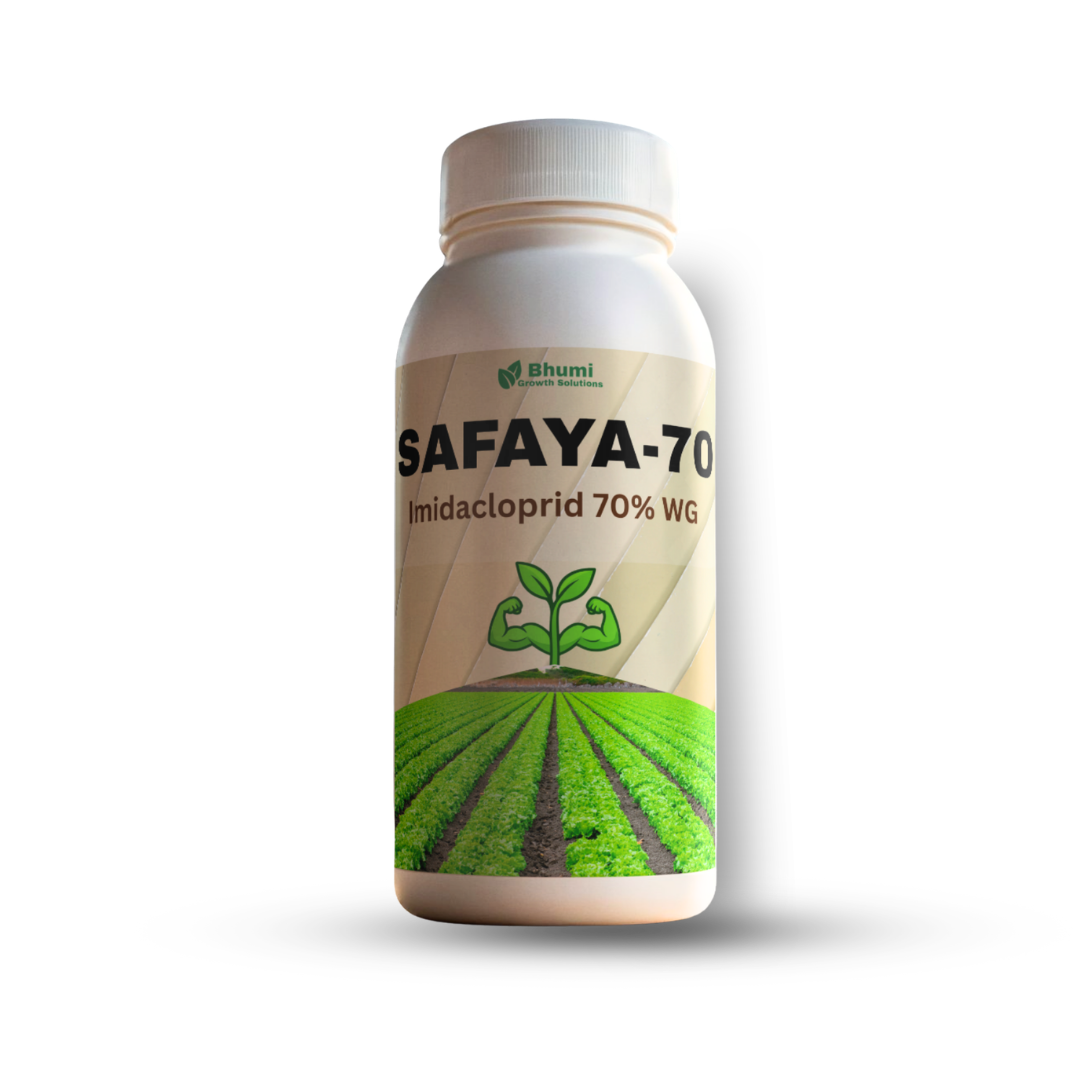
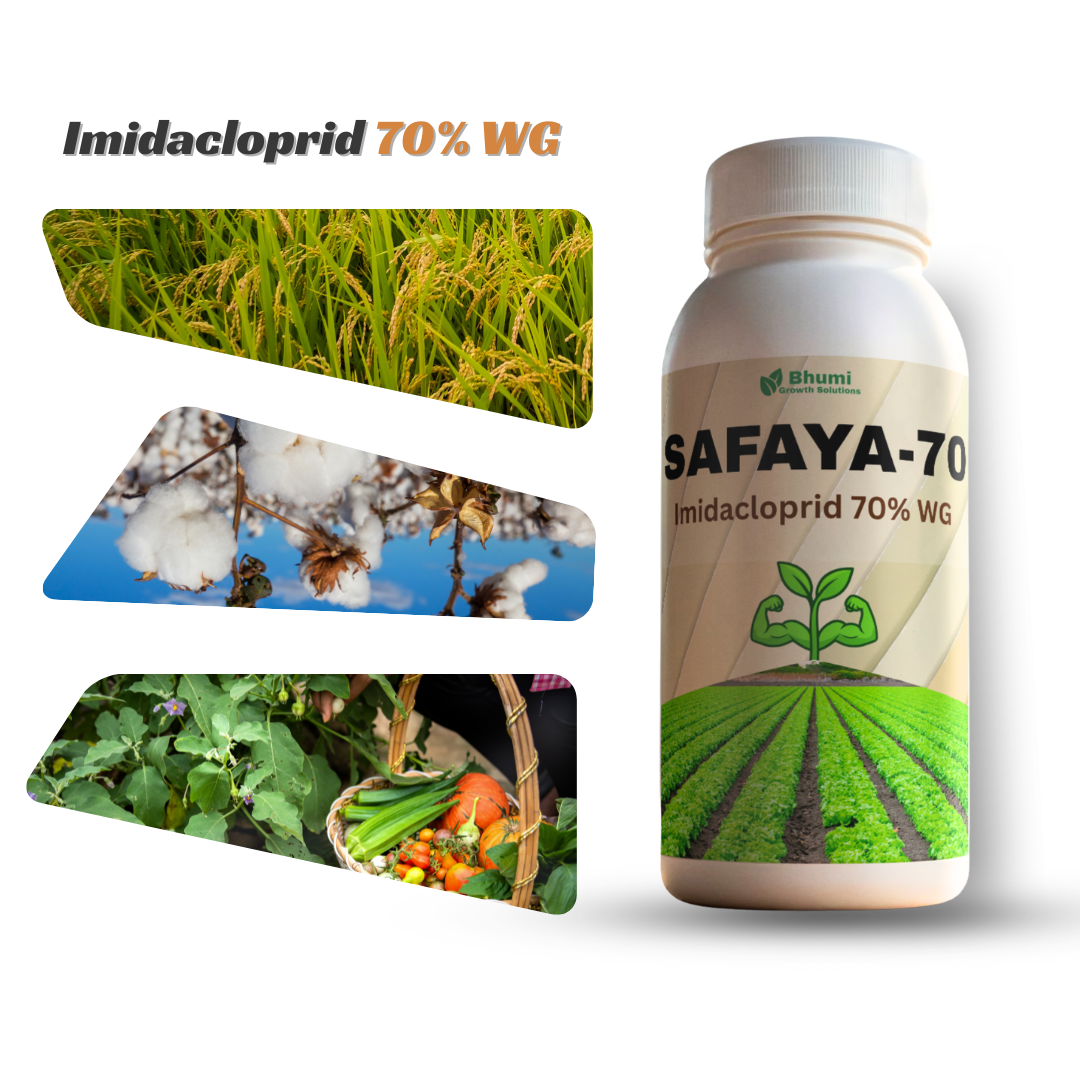
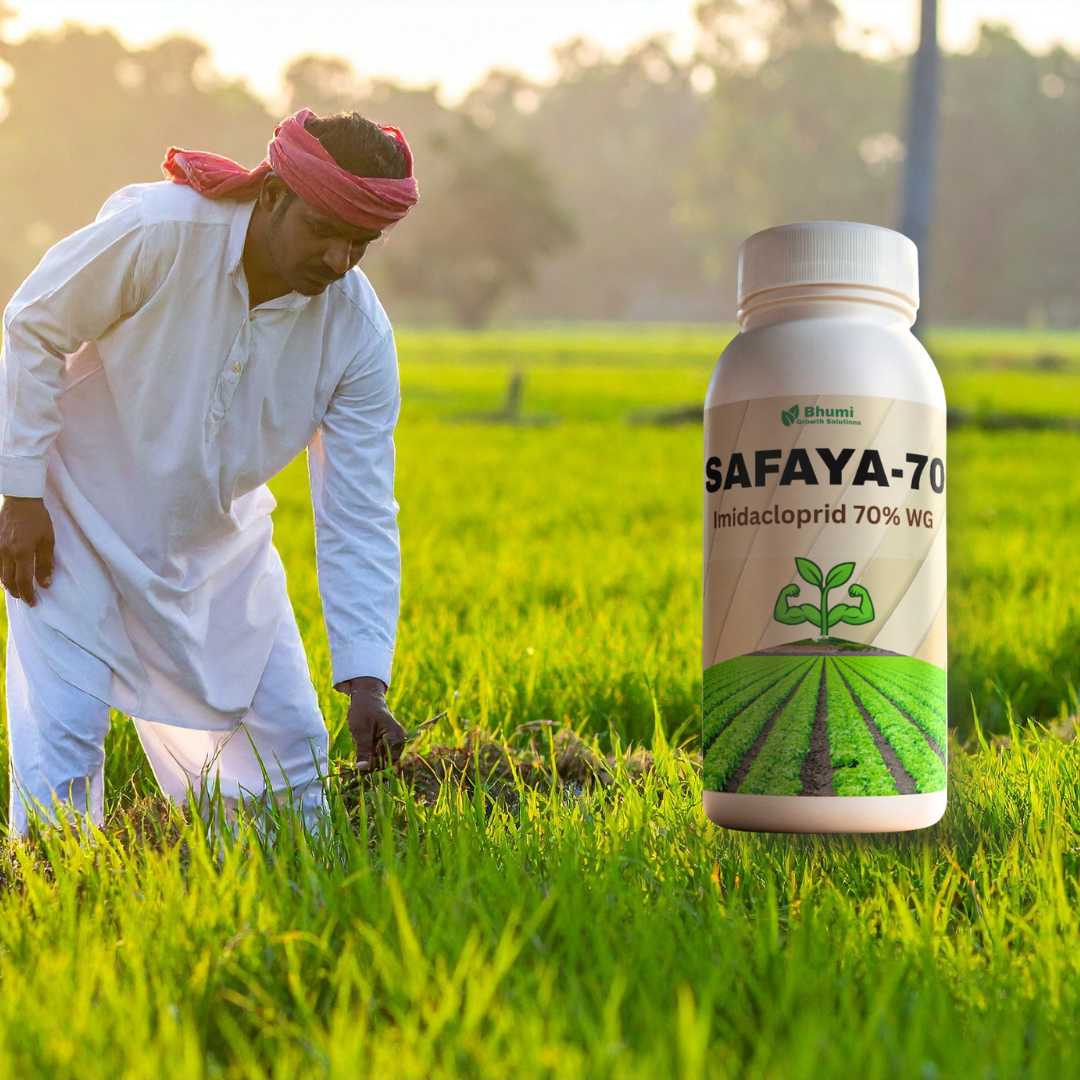
SAFAYA-70 is a professional-grade Imidacloprid 70% w/w Water Dispersible Granules (WG) insecticide from Bhumi Growth Solutions — one of the most concentrated Imidacloprid formulations registered for agricultural use in India. At 70% active ingredient loading, SAFAYA-70 delivers unmatched potency per gram, meaning farmers need significantly less product per acre compared to lower-concentration liquid formulations — reducing packaging, storage, and handling costs without compromising on pest control performance.
The WG (Water Dispersible Granules) formulation is a key technical advantage. Unlike traditional Wettable Powders (WP) that create dusty, messy preparations, SAFAYA-70’s granules are clean, easy to measure, and dissolve completely and uniformly in water — leaving no undissolved residue in the spray tank, no nozzle clogging, and no dusty exposure hazard during handling. The resulting spray solution has excellent suspensibility and provides superior, uniform leaf coverage across the entire crop canopy.
Available in a standard 1 Kg pack — and in custom sizes from 100g to bulk quantities for distributors and institutional buyers — SAFAYA-70 is built to serve every scale of farming, from smallholder vegetable plots to large commercial cotton and sugarcane estates.
Why WG Formulation? The SAFAYA-70 Formulation Advantage
Not all Imidacloprid formulations are equal. Here’s why the 70% WG formulation in SAFAYA-70 stands apart from older liquid and powder formats:
| Parameter | AI Content | Physical Form | Dose/Acre | Water Mixing | Shelf Life | Economics |
| Imidacloprid 70% WG (SAFAYA-70) | 70% active ingredient | Granules — clean, dust-free | 25–60 gm/acre | Excellent — complete dissolution | 2 years+ (dry, stable storage) | Lowest cost per acre treated |
| Imidacloprid 30.5% SC (IMIDA Max-305) | 30.5% active ingredient | Liquid suspension | 24–60 ml/acre | Good — pre-suspended | 2 years (cool storage) | Moderate cost per acre |
| Imidacloprid 17.8% SL | 17.8% active ingredient | Soluble liquid | 60–125 ml/acre | Excellent — fully soluble | 2 years | Higher volume per acre |
Key WG Formulation Benefits:
- Dust-free, granular form — no respiratory exposure risk during weighing and measuring, unlike WP powders
- Complete water dissolution — no undissolved particles, no nozzle blockage, consistent spray concentration throughout the tank
- Stable in storage — dry granules are not affected by freezing temperatures like liquid formulations
- Lightweight & compact — 1 Kg WG replaces ~2.3 litres of 30.5% SC or ~4 litres of 17.8% SL for the same number of acre treatments
- Precise dosing — granules are easy to weigh accurately on a simple kitchen or field scale
- Long shelf life — dry formulation maintains full potency for 2+ years under standard storage conditions
How Does SAFAYA-70 Work? (Mode of Action)
SAFAYA-70 operates through the same well-documented biochemical mechanism as all Imidacloprid formulations, with the key advantage that the higher 70% concentration delivers a greater density of active molecules per unit volume of spray solution:
- Systemic Absorption & Translocation: Once applied as a foliar spray, SAFAYA-70 is rapidly absorbed through the leaf cuticle and stomata. The active Imidacloprid molecules enter the plant’s vascular system (xylem) and translocate acropetally (upward) to all green tissues — including newly emerging leaves and growing tips. This systemic movement ensures protection even of plant parts that were not directly sprayed.
- Soil Uptake (Root Systemic): When applied as a soil drench or incorporated into furrows, Imidacloprid is absorbed through plant roots and translocated upward throughout the entire plant — making SAFAYA-70 uniquely effective for soil-dwelling pests like Termites and White Grubs that never come into contact with foliar sprays.
- nAChR Irreversible Binding: Imidacloprid binds with high affinity and irreversibility to nicotinic acetylcholine receptors (nAChRs) in the insect’s central nervous system. Insect nAChRs have a much higher sensitivity to Imidacloprid than mammalian receptors — which is the biochemical basis for the molecule’s selective toxicity to insects over mammals.
- Continuous Nerve Excitation → Paralysis: Binding of Imidacloprid to nAChRs prevents the normal breakdown of acetylcholine, causing continuous and uncontrolled nerve signal firing throughout the insect’s nervous system. This hyperexcitation leads to rapid loss of motor coordination, paralysis, cessation of feeding, and death.
- Contact Action: Imidacloprid in SAFAYA-70 also exerts direct contact toxicity — insects walking on or landing on treated leaf surfaces absorb the active ingredient through their tarsal pads and cuticle, triggering the same neurological cascade even without ingesting plant tissue.
- Phytotonic Effect: An additional agronomic benefit of Imidacloprid 70% WG — documented in field trials and referenced in Bayer’s Admire WG technical literature — is a measurable phytotonic (plant growth stimulating) effect on treated crops, resulting in more vigorous vegetative growth and enhanced stress tolerance.
Target Pests
| Target Pest (Scientific Name) | Key Crops |
| Jassids / Leafhoppers (Amrasca biguttula) | Cotton, Brinjal, Okra, Vegetables |
| Aphids (Aphis gossypii, Myzus persicae) | Cotton, Wheat, Chilli, Vegetables, Oilseeds |
| Thrips (Thrips tabaci, Scirtothrips dorsalis) | Cotton, Chilli, Onion, Grapes, Groundnut |
| Whiteflies (Bemisia tabaci) | Cotton, Tomato, Chilli, Cucumber, Vegetables |
| Brown Plant Hopper / BPH (Nilaparvata lugens) | Rice / Paddy |
| White-Backed Plant Hopper / WBPH (Sogatella furcifera) | Rice / Paddy |
| Termites (Odontotermes spp.) | Sugarcane, Cotton, Wheat — Soil Treatment |
| White Grubs (Holotrichia spp.) | Sugarcane, Groundnut, Potato — Soil Treatment |
| Mealybugs & Scale Insects | Grapes, Pomegranate, Citrus, Mango |
Crop-Wise Dosage & Application Table
📌 DOSAGE NOTE: The following rates are verified from multiple registered Imidacloprid 70% WG product labels and CIB&RC-approved crop recommendations (Bayer Admire 70WG, and comparable branded products). Please verify against your actual CIB-registered label before publishing on the website.
| Crop | Target Pests | Method | Dose Per Acre | Dilution Rate |
| Cotton | Jassids, Aphids, Thrips, Whiteflies | Foliar Spray | 40–50 gm per acre | 0.5–0.6 gm per litre of water |
| Rice / Paddy | BPH, WBPH, Leafhoppers | Foliar Spray | 25–40 gm per acre | 0.3–0.5 gm per litre of water |
| Tomato | Whiteflies, Aphids, Thrips | Foliar Spray | 20–25 gm per acre | 0.3 gm per litre of water |
| Cucumber / Cucurbits | Jassids, Aphids, Whiteflies | Foliar Spray | 12–15 gm per acre | 0.2 gm per litre of water |
| Chilli | Aphids, Thrips, Whiteflies | Foliar Spray | 30–40 gm per acre | 0.4–0.5 gm per litre of water |
| Okra / Bhindi | Jassids, Aphids, Whiteflies | Foliar Spray | 25–30 gm per acre | 0.3–0.4 gm per litre of water |
| Sugarcane | Termites, Pyrilla, Early Shoot Borer | Soil Drench / Furrow | 50–60 gm per acre | 0.3–0.5 gm per litre water |
| Mango / Fruits | Leafhoppers, Mealybugs, Scale | Foliar Spray | 30–40 gm per acre | 0.3–0.4 gm per litre of water |
| Soil Treatment (Termites) | Termites | Soil Drench | 0.3–0.5 gm per litre water | Apply uniformly to root zone |
How to Prepare SAFAYA-70 Spray Solution
- Step 1: Weigh the required amount of SAFAYA-70 granules accurately using a clean, dry measuring scale
- Step 2: Fill the spray tank with half the required volume of clean water (pH 5.5–7.0 preferred)
- Step 3: Add the measured quantity of SAFAYA-70 granules directly to the water in the tank
- Step 4: Stir or agitate the solution thoroughly for 2–3 minutes until all granules are completely dissolved — no visible particles should remain
- Step 5: Top up the tank with the remaining water volume and agitate once more
- Step 6: Begin spraying immediately — spray both the upper and lower leaf surfaces for complete coverage
- Step 7: Clean the spray tank and equipment thoroughly with clean water after use
Application Tips for Best Results
- Spray in early morning (before 10 AM) or late evening (after 5 PM) — avoid peak heat and strong winds
- For sucking pest control, ensure thorough coverage of leaf undersides where aphids, whiteflies, and jassids congregate
- Do not mix with strongly alkaline products (lime, Bordeaux mixture, copper oxychloride) — use neutral to slightly acidic water
- Rotate with IRAC Group 28 (Diamides) or Group 6 (Avermectins) after 2 consecutive applications to prevent neonicotinoid resistance
- For maximum systemic activity, apply when pest populations are at early build-up stage — before heavy infestation sets in
- In drip-irrigated crops, SAFAYA-70 can be injected through the fertigation system for direct root-zone application
- Always wear gloves, mask, and protective clothing during weighing, mixing, and spraying operations
Key Benefits at a Glance
- ✅ Maximum Concentration (70% AI) — Lowest dose per acre = Lowest cost per crop treatment
- ✅ Clean WG Formulation — Dust-free granules, complete water dissolution, zero tank residue
- ✅ Triple-Action Control — Systemic + Contact + Stomach for comprehensive pest coverage
- ✅ Rapid Knockdown — Feeding inhibition within hours; pest mortality within 24–48 hours
- ✅ 21-Day Residual Protection — Long-lasting systemic coverage reduces spray frequency
- ✅ Broad-Spectrum — Controls 9+ economically important sucking and soil pest species
- ✅ Protects New Growth — Systemic translocation shields emerging shoots and leaves
- ✅ Phytotonic Effect — Documented stimulatory effect on crop vigour and stress tolerance
- ✅ Versatile — Foliar spray, soil drench, furrow application, or drip fertigation
- ✅ Excellent Shelf Life — Dry granule formulation stable for 2+ years under standard storage
SAFAYA-70 (70% WG) vs IMIDA Max-305 (30.5% SC): Which to Choose?
| Parameter | SAFAYA-70 (70% WG) | IMIDA Max-305 (30.5% SC) |
| Active Ingredient | Imidacloprid 70% WG | Imidacloprid 30.5% SC |
| Formulation | Dry granules (WG) | Liquid suspension (SC) |
| Concentration | 70% w/w (highest available) | 30.5% w/v |
| Dose per Acre | 25–60 gm per acre | 24–60 ml per acre |
| Water Mixing | Complete dissolution — no residue | Shake before use — suspension |
| Storage | Dry, stable — 2+ years | Cool, dry — 2 years |
| Best For | High-value crops, bulk/commercial use, cost efficiency | Ready-to-use liquid convenience |
| Pack Size | 1 Kg (custom available) | 1 Litre (custom available) |
Available Pack Sizes
Standard Size: 1 Kg
Custom Sizes: 100g | 250g | 500g | 1 Kg | Bulk quantities (for distributors & dealers)
As a manufacturer and supplier, Bhumi Growth Solutions offers custom packaging and private labelling for agri-retailers, distributors, FPOs, and institutional buyers.
Resistance Management Advisory
⚠️ IMPORTANT — Resistance Management:
• Imidacloprid belongs to IRAC Group 4A (Neonicotinoids) — the same group as IMIDA Max-305
• Do not apply more than 2 consecutive sprays of SAFAYA-70 or any other IRAC Group 4A product per season
• After 2 applications, rotate with IRAC Group 28 (Chlorantraniliprole/Rynaxypyr), Group 6 (Abamectin), or Group 23 (Spirotetramat)
• Use as part of a structured IPM programme — do not use as a calendar-based prophylactic spray
• Do NOT tank mix with other neonicotinoids (Thiamethoxam, Acetamiprid, Clothianidin) — counts as same IRAC group
Safety, Precautions & First Aid
- Wear full PPE: gloves, protective goggles, full-sleeve clothing, nose-mouth mask when handling, weighing, and spraying
- Store in original sealed container in a cool, dry, locked place — away from children, food, and water sources
- Do NOT spray near ponds, lakes, canals, or water bodies — Imidacloprid is toxic to aquatic organisms and honeybees
- Avoid spraying on flowering crops during peak bee foraging hours — apply in early morning or late evening only
- Do NOT smoke, eat, or drink during weighing and spraying operations
- If inhaled (dust): Move to fresh air immediately; seek medical attention if respiratory symptoms persist
- If skin contact: Wash thoroughly with soap and water for at least 15 minutes
- If eye contact: Flush immediately with clean running water for 15–20 minutes; consult a physician
- If ingested: Do NOT induce vomiting; seek immediate medical attention and show product label to physician
- No specific antidote — treat symptomatically; atropine may be used for cholinergic symptoms under medical supervision
- Rinse empty containers triple times before disposal; never reuse containers for food or water storage
Frequently Asked Questions (FAQs)
Q1. What is Imidacloprid 70% WG and how is it different from other Imidacloprid formulations?
Imidacloprid 70% WG (Water Dispersible Granules) is the most concentrated commercial formulation of Imidacloprid available, containing 70% active ingredient in a clean, dust-free granular form. Compared to 30.5% SC (liquid) or 17.8% SL, the 70% WG requires far less product per acre treatment — making it the most cost-efficient Imidacloprid formulation for commercial farmers. The WG form also offers superior shelf life, easier storage, and cleaner mixing vs liquid alternatives.
Q2. What is the correct dose of SAFAYA-70 per acre?
Dosage varies by crop and pest. General rates: Cotton (40–50 gm/acre), Rice (25–40 gm/acre), Tomato (20–25 gm/acre), Cucumber (12–15 gm/acre), Chilli (30–40 gm/acre), Sugarcane/Termite soil treatment (50–60 gm/acre). Dilution: approximately 0.3–0.6 gm per litre of water depending on crop. Always verify with the CIB-registered label before use.
Q3. Which pests does SAFAYA-70 control?
SAFAYA-70 controls Jassids, Aphids, Thrips, Whiteflies, Brown Plant Hoppers (BPH), White-Backed Plant Hoppers (WBPH), Termites, White Grubs, Mealybugs, and Scale Insects — covering virtually all economically damaging sucking and soil pests across major Indian crop systems.
Q4. How quickly does SAFAYA-70 work?
SAFAYA-70 inhibits pest feeding within hours of application. Visible pest knockdown (mortality) is typically observed within 24–48 hours. The systemic residual activity provides continued crop protection for 14–21 days after each application, depending on pest pressure and crop growth stage.
Q5. Can I use SAFAYA-70 for drip irrigation or soil application?
Yes. SAFAYA-70 granules dissolve completely in water and can be applied through drip fertigation systems for direct root-zone systemic uptake. For soil-dwelling pests like termites and white grubs, it can be applied as a soil drench at 0.3–0.5 gm per litre of water directed at the root zone.
Q6. How to manage resistance with SAFAYA-70?
Limit SAFAYA-70 and all IRAC Group 4A neonicotinoids to a maximum of 2 consecutive applications per crop season. Then rotate to a product from a different IRAC group — such as Group 28 (Diamides like Chlorantraniliprole) or Group 6 (Abamectin). Avoid mixing with other neonicotinoids. Use as part of a structured IPM programme for sustainable long-term pest management.

Reviews
There are no reviews yet.