

Description
What is LAMBDORA?
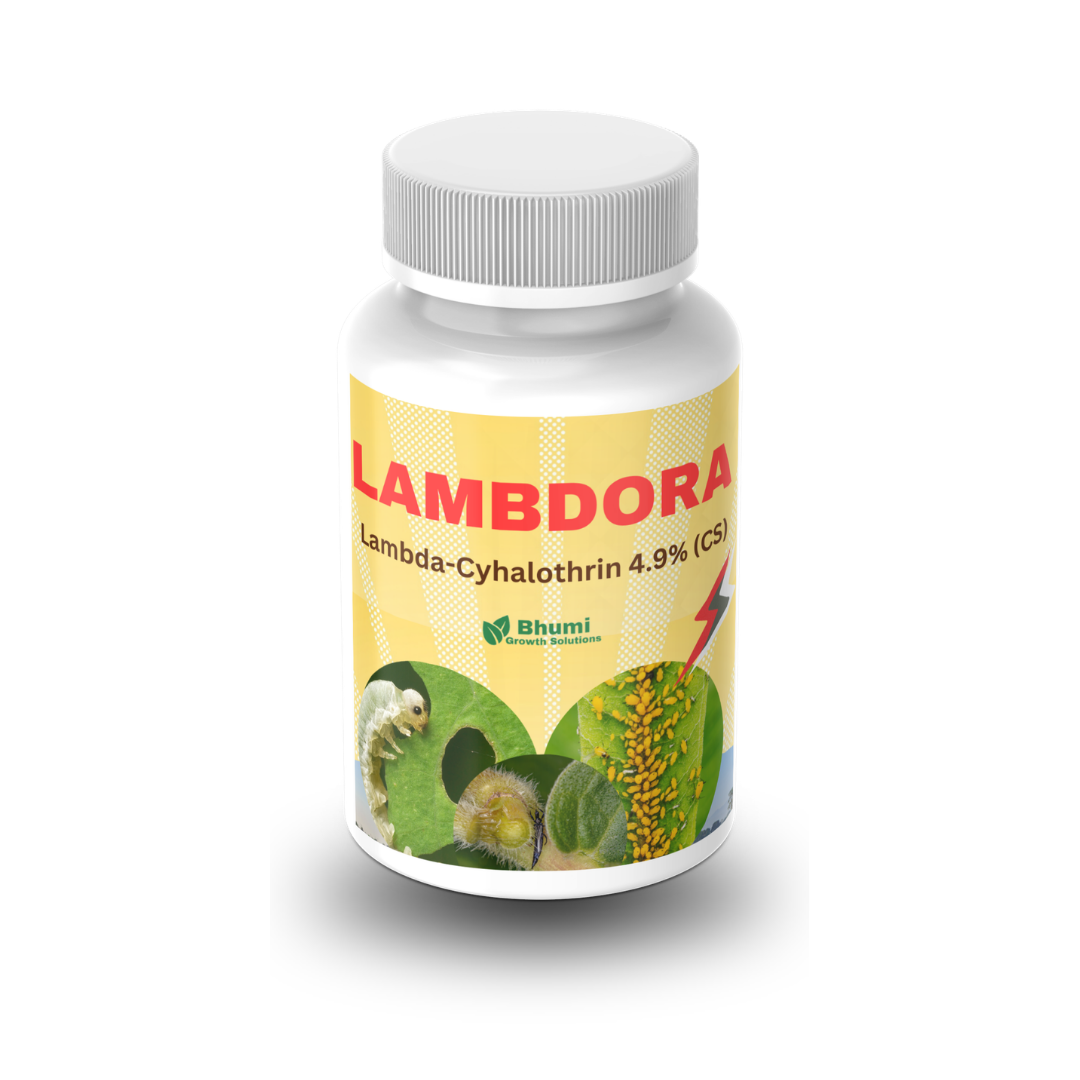
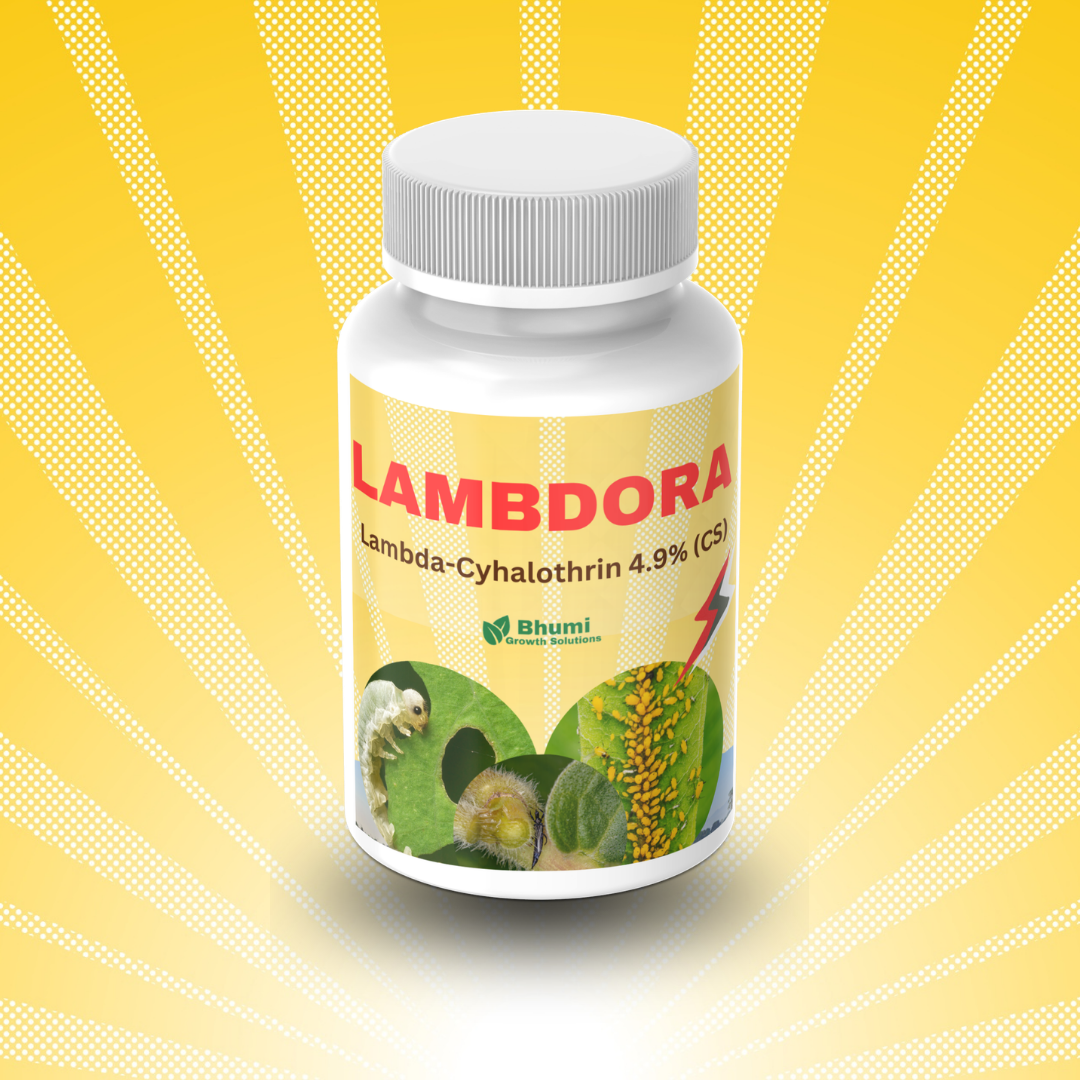
LAMBDORA is a high-performance Lambda-Cyhalothrin 4.9% w/v Capsule Suspension (CS) insecticide from Bhumi Growth Solutions. Belonging to the Synthetic Pyrethroid chemical class (IRAC Group 3A), LAMBDORA works through a fundamentally different biochemical mechanism from neonicotinoid insecticides like Imidacloprid — making it one of the most strategically important tools in any modern Indian farmer’s Integrated Pest Management (IPM) programme.
Lambda-Cyhalothrin is one of the most widely registered and extensively researched synthetic pyrethroid active ingredients in global agriculture — with proven efficacy against the most economically damaging insect pest species across India’s major crop systems. In LAMBDORA, this powerful active ingredient is formulated using advanced Capsule Suspension (CS) microencapsulation technology — delivering superior residual activity, improved safety during handling, and reduced phytotoxicity risk compared to traditional EC (Emulsifiable Concentrate) formulations of pyrethroids.
Available in a standard 1 Litre pack and in custom sizes from 100 ml to bulk quantities for distributors and institutional buyers — LAMBDORA is the versatile, fast-acting, and strategically essential insecticide that completes the Bhumi Growth Solutions crop protection range.
The Technology Edge: What is CS (Capsule Suspension)?
CS (Capsule Suspension) is the most advanced commercial formulation technology for pyrethroid insecticides — a significant leap forward from traditional EC (Emulsifiable Concentrate) products. In LAMBDORA, the Lambda-Cyhalothrin active ingredient is microencapsulated — sealed inside thousands of tiny, thin-walled polymer capsules that are uniformly suspended in a water carrier.
These microscopic capsules perform a critical function — they protect the active ingredient from UV degradation and rapid evaporation after spraying, and release it in a controlled, sustained manner only when the capsule wall is disrupted by contact with an insect’s body or when the spray deposit dries on the leaf surface. This “triggered release” mechanism is what gives LAMBDORA its distinctive combination of fast initial knockdown with extended residual pest control.
CS Technology Advantages over Traditional EC (Emulsifiable Concentrate):
| Parameter | LAMBDORA CS | Traditional EC |
| Residual Activity | Up to 21 days extended residual (capsules release AI gradually over time) | Shorter residual — active ingredient fully exposed and degraded faster |
| UV Stability | Capsule walls protect AI from UV degradation — maintains potency longer in field | Directly exposed — UV-sensitive active ingredient degrades rapidly |
| Phytotoxicity Risk | Lower — solvent-free, no organic solvents that can damage waxy leaf cuticle | Higher — EC solvents can damage delicate crop tissues, especially in hot weather |
| Handling Safety | Safer to handle — encapsulated AI reduces skin/eye absorption during mixing | Higher dermal/ocular exposure risk during handling and mixing |
| Odour | Significantly reduced spray odour (AI enclosed in capsules) | Strong characteristic odour from EC solvents |
| Rain Fastness | Superior — capsules adhere to leaf surface and resist wash-off | Moderate — emulsified droplets more susceptible to rain wash-off |
| Water Mixing | Milky white suspension — easily disperses in water | Forms emulsion with some foaming |
How Does LAMBDORA Work? (Mode of Action)
LAMBDORA operates through IRAC Group 3A’s voltage-dependent sodium channel modulation — a completely different mechanism from IRAC Group 4A neonicotinoids, making cross-resistance between these two groups extremely unlikely:
- Contact Uptake: When a pest contacts a LAMBDORA-treated surface, the capsule wall is disrupted by the insect’s body movement and cuticular lipids, triggering rapid release of Lambda-Cyhalothrin. The active ingredient is absorbed through the insect’s cuticle (exoskeleton) and enters the nervous system within minutes — producing the characteristic rapid knockdown effect.
- Stomach Action: When a pest ingests treated plant tissue, Lambda-Cyhalothrin is absorbed rapidly through the gut lining into the haemolymph (insect blood), reaching nerve axons throughout the body and producing the same neurological cascade.
- Sodium Channel Hyperactivation: Lambda-Cyhalothrin binds to voltage-gated sodium channels in insect nerve axon membranes, holding them open in a permanently activated state. Under normal physiology, these channels open briefly during a nerve impulse and then close. Pyrethroid binding prevents closure, causing a continuous, uncontrolled influx of sodium ions into the nerve cell.
- Nerve Hyperexcitation → Paralysis: The sustained sodium influx causes uncontrolled, repetitive nerve firing throughout the insect’s peripheral and central nervous system. This manifests as rapid hyperexcitation, uncontrolled muscle spasms (knockdown effect visible within minutes to hours), progressive paralysis, and death.
- Repellent Effect: Lambda-Cyhalothrin has a well-documented repellent property — insects that approach or land on treated surfaces detect the chemical via chemoreceptors and are deterred from feeding, mating, or ovipositing (egg-laying) on treated crops. This sub-lethal repellent effect adds a significant additional layer of crop protection beyond direct pest mortality.
- Capsule Release Mechanism: The CS microencapsulation provides a unique two-phase kill: an immediate “burst release” from capsules disrupted by initial insect contact (rapid knockdown), followed by a sustained slow release from intact capsules on the leaf surface over the following 14–21 days (residual protection against subsequent pest arrivals).
Target Pests
| Target Pest (Scientific Name) | Key Crops |
| Bollworms (Helicoverpa armigera, Pectinophora gossypiella, Earias spp.) | Cotton |
| Hairy Caterpillar / Tobacco Caterpillar (Spodoptera litura) | Cotton, Soybean, Groundnut, Vegetables |
| American Bollworm / Gram Pod Borer (Helicoverpa armigera) | Chilli, Tomato, Chickpea, Soybean |
| Stem Borer (Chilo partellus, Scirpophaga spp.) | Rice, Maize, Sorghum |
| Leaf Folder (Cnaphalocrocis medinalis) | Rice / Paddy |
| Fruit & Shoot Borer (Leucinodes orbonalis) | Brinjal |
| Pod Borer (Maruca vitrata, Helicoverpa armigera) | Chilli, Chickpea, Pigeonpea |
| Fruit Borer (Leucinodes orbonalis) | Okra, Tomato |
| Aphids (Aphis gossypii, Myzus persicae) | Cotton, Chilli, Vegetables |
| Thrips (Thrips tabaci, Scirtothrips dorsalis) | Cotton, Chilli, Grapes, Onion |
| Flea Beetles (Siphanta acuta) | Grapes |
| Semilooper (Chrysodeixis acuta) | Soybean, Cotton |
| Stem Fly (Melanagromyza sojae) | Soybean |
| Shoot & Capsule Borer, Thrips | Cardamom |
CIB-Verified Crop-Wise Dosage & Application Table
| Crop | Target Pests | Method | Dose/Acre | Water/Acre | Dilution Rate | PHI (Days) |
| Cotton | Bollworms (American, Spotted, Pink) | Foliar Spray | 200 ml | 200 L | 1 ml/L | 21 days |
| Rice / Paddy | Stem Borer, Leaf Folder | Foliar Spray | 100 ml | 200 L | 0.5 ml/L | As per label |
| Brinjal | Fruit & Shoot Borer | Foliar Spray | 120–150 ml | 200 L | 0.6–0.75 ml/L | As per label |
| Okra / Bhindi | Fruit Borer, Thrips | Foliar Spray | 120–150 ml | 200 L | 0.6–0.75 ml/L | As per label |
| Tomato | Fruit Borer, Leaf Miner | Foliar Spray | 120–150 ml | 200 L | 0.6–0.75 ml/L | As per label |
| Chilli | Thrips, Pod Borer | Foliar Spray | 200 ml | 200 L | 1 ml/L | 5 days |
| Soybean | Stem Fly, Semilooper | Foliar Spray | 120 ml | 200 L | 0.6 ml/L | 31 days |
| Grapes | Thrips, Flea Beetle | Foliar Spray | 100 ml | 200–400 L | 0.5 ml/L | 7 days |
| Cardamom | Shoot & Capsule Borer, Thrips | Foliar Spray | 160 ml | 400 L | 0.4 ml/L | 34 days |
| General Use | All crops / Home garden | Foliar Spray | 300 ml/acre | 200 L | 2 ml/L (domestic) | Crop-specific |
💡 QUICK REFERENCE:
• 15-litre knapsack pump: 30 ml per pump
• General domestic/garden use: 2–4 ml per litre of water
• Per acre (general): 200–300 ml in 200 litres of water
How to Prepare LAMBDORA Spray Solution
- Step 1: Shake the LAMBDORA bottle well before measuring — the microencapsulated suspension may settle slightly during storage
- Step 2: Measure the required volume of LAMBDORA accurately using a graduated cylinder or measuring cup
- Step 3: Fill the spray tank half-full with clean water (pH 5.5–7.0)
- Step 4: Add the measured LAMBDORA to the water and stir gently — the milky white suspension disperses evenly without vigorous agitation
- Step 5: Top up with remaining water and stir once more to ensure uniform suspension
- Step 6: Begin spraying immediately on both upper and lower leaf surfaces, directing the nozzle toward the crop canopy and fruiting bodies
- Step 7: For bollworm control in cotton, focus spray on boll development zone; for leaf folders in rice, direct spray toward rolled/folded leaves
- Step 8: Rinse spray equipment thoroughly with clean water after use
Application Tips for Best Results
- Apply at first detection of pest eggs or early instar larvae — young caterpillars are far more susceptible than mature larvae; early application prevents crop damage before it becomes economic
- Spray in early morning (6–9 AM) or late evening (after 5 PM) — UV radiation during midday degrades pyrethroids even in CS formulation; also reduces heat stress phytotoxicity risk
- For Bollworm control in cotton, rotate LAMBDORA with IMIDA Max-305 or IMIDA-178 — bollworms are notorious for rapid resistance development; alternating between IRAC Group 3A and 4A is critical for sustained season-long control
- Do NOT mix with strongly alkaline products (lime, Bordeaux mixture) — pyrethroids are hydrolysed (broken down) under high pH conditions
- CS formulation is rain-fast within 1–2 hours of spray drying — avoid spraying immediately before forecast rain
- Wear full PPE during spraying — pyrethroids cause tingling/burning sensation on skin; CS formulation reduces but does not eliminate this risk
- For home garden/kitchen garden use: 2–4 ml per litre of water is safe for all vegetables
IPM Strategy: LAMBDORA as the Perfect IMIDA Rotation Partner
🔄 RESISTANCE MANAGEMENT — IPM ROTATION PROGRAMME:
The Bhumi Growth Solutions range now offers a complete, science-based IPM rotation programme:
Spray 1 (IRAC Group 4A — Neonicotinoid): IMIDA-178 / IMIDA Max-305 / SAFAYA-70
↓ 10–14 days later
Spray 2 (IRAC Group 4A — Neonicotinoid): IMIDA-178 / IMIDA Max-305 / SAFAYA-70
↓ 10–14 days later
Spray 3 (IRAC Group 3A — Pyrethroid): LAMBDORA (Lambda-Cyhalothrin 4.9% CS)
↓ 10–14 days later
Spray 4 (IRAC Group 3A — Pyrethroid): LAMBDORA
↓ THEN RETURN TO IRAC Group 4A if pest pressure continues
✅ This rotation prevents resistance in BOTH neonicotinoid AND pyrethroid-resistant pest populations
✅ LAMBDORA targets BOLLWORMS & CATERPILLARS — pests that Imidacloprid alone does not fully control
✅ Together, the Bhumi range covers ALL major sucking, chewing, and burrowing pest categories
Key Benefits at a Glance
- ✅ IRAC Group 3A Pyrethroid — Completely different mode of action from Imidacloprid; perfect IPM rotation partner
- ✅ CS Microencapsulation — Advanced formulation for longer residual, safer handling, lower phytotoxicity
- ✅ Lightning Fast Knockdown — Pest immobilisation visible within minutes to hours of contact
- ✅ 21-Day Residual Protection — Sustained capsule release protects new pest arrivals over 3 weeks
- ✅ Repellent Activity — Deters feeding, mating, and egg-laying on treated crop surfaces
- ✅ Broad-Spectrum Chewing + Sucking Pest Control — Bollworms, caterpillars, borers, AND aphids, thrips
- ✅ Rain-Fast within 1–2 hours — Capsules adhere to leaf surface and resist wash-off
- ✅ Reduced Phytotoxicity vs EC — Solvent-free CS formulation safer for sensitive crops and hot conditions
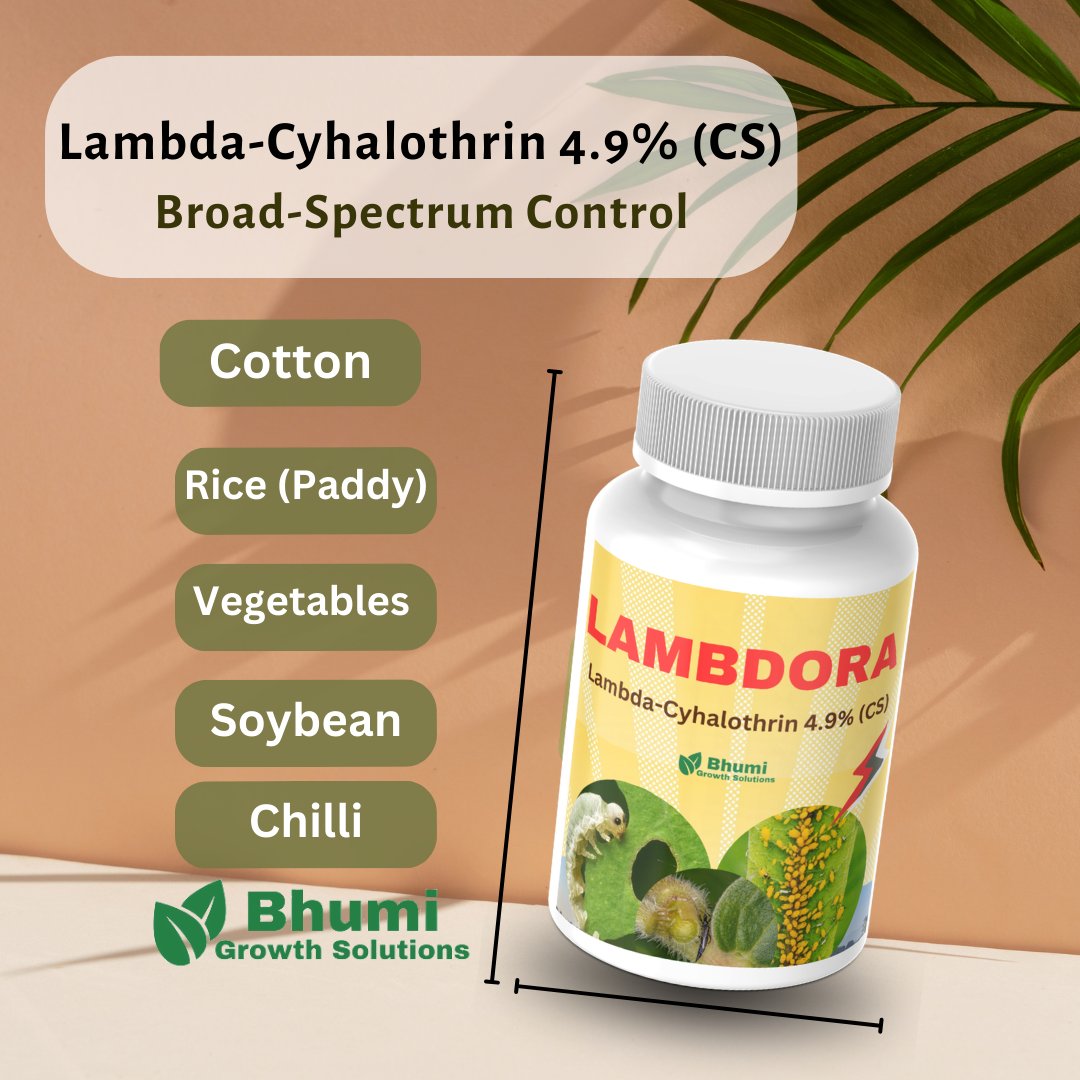
- ✅ Wide Crop Registration — Cotton, Rice, Brinjal, Okra, Tomato, Chilli, Soybean, Grapes, Cardamom
- ✅ Multiple Pack Sizes — From 100 ml home garden to bulk commercial quantities
Available Pack Sizes
Standard Size: 1 Litre
Custom Sizes: 100 ml | 250 ml | 500 ml | 1 Litre | Bulk quantities
Safety, Precautions & First Aid
- Always wear full PPE: chemical-resistant gloves, protective goggles, full-sleeve clothing, and nose-mouth mask during handling, mixing, and spraying
- Pyrethroids cause a tingling/burning sensation (paresthesia) on exposed skin — CS formulation reduces but does not eliminate this; wear gloves and long sleeves
- Store in original tightly sealed container in a cool, dry, locked location — away from children, food, and water sources
- DO NOT spray near water bodies (ponds, rivers, canals) — Lambda-Cyhalothrin is HIGHLY TOXIC to fish, aquatic invertebrates, and honeybees
- DO NOT spray on flowering crops during pollinator activity hours — spray only in early morning or late evening to protect bees
- Do NOT smoke, eat, or drink while handling or spraying
- If skin contact (paresthesia/tingling): Wash immediately with soap and water; apply vitamin E oil or baby oil to reduce tingling sensation
- If eye contact: Immediately flush with clean running water for 15–20 minutes; consult ophthalmologist if irritation persists
- If inhaled: Move to fresh air; if breathing difficulty persists, seek immediate medical attention
- If ingested: Do NOT induce vomiting; seek immediate emergency medical care; show label to physician
- No specific antidote — supportive treatment; atropine not required (pyrethroids do NOT inhibit acetylcholinesterase)
- Triple-rinse empty containers before disposal; never reuse for food or water storage
Frequently Asked Questions (FAQs)
Q1. What is Lambda-Cyhalothrin 4.9% CS and how does it differ from EC formulations?
Lambda-Cyhalothrin 4.9% CS (Capsule Suspension) uses advanced microencapsulation technology — the active ingredient is enclosed in tiny polymer capsules that only release when disrupted by insect contact or as the spray deposit dries. This gives LAMBDORA significantly longer residual activity (up to 21 days), lower phytotoxicity risk, reduced spray odour, better rain fastness, and safer handling compared to traditional EC (Emulsifiable Concentrate) formulations of pyrethroids.
Q2. What pests does LAMBDORA control?
LAMBDORA controls Bollworms (American, Spotted, Pink), Hairy Caterpillars, Tobacco Caterpillars, Stem Borers, Leaf Folders, Fruit & Shoot Borers (Brinjal), Pod Borers (Chilli, Soybean), Semiloopers, Stem Flies, Aphids, Thrips, and Flea Beetles — across Cotton, Rice, Chilli, Brinjal, Okra, Tomato, Soybean, Grapes, and Cardamom.
Q3. What is the dosage of LAMBDORA per acre?
Cotton (Bollworms): 200 ml/acre in 200 L water. Rice (Stem Borer, Leaf Folder): 100 ml/acre. Brinjal, Okra, Tomato: 120–150 ml/acre. Chilli: 200 ml/acre. Soybean: 120 ml/acre. Grapes: 100 ml/acre. General use: 2 ml per litre of water; 30 ml per 15-litre pump. Source: Multiple CIB-registered Lambda-Cyhalothrin 4.9% CS product labels.
Q4. Why is LAMBDORA the ideal rotation partner for IMIDA-178, IMIDA Max-305, and SAFAYA-70?
LAMBDORA (IRAC Group 3A — Pyrethroid) has a completely different mode of action from IMIDA-178/Max-305/SAFAYA-70 (IRAC Group 4A — Neonicotinoid). Rotating between these two IRAC groups prevents resistance development in pest populations. Additionally, LAMBDORA covers bollworms, caterpillars, and borers that neonicotinoids do not fully control — making the combined use of both groups essential for complete, season-long pest management.
Q5. How quickly does LAMBDORA work?
LAMBDORA provides extremely rapid knockdown — pests in direct contact with treated surfaces are immobilised within minutes to hours due to the burst-release effect of disrupted CS capsules. Full pest mortality typically occurs within 24 hours of exposure. The residual protection then continues for 14–21 days as intact capsules on the leaf surface continue releasing active ingredient.
Q6. Is LAMBDORA safe to use near water bodies?
No. Lambda-Cyhalothrin is HIGHLY TOXIC to fish, aquatic invertebrates, and honeybees. Do NOT apply near ponds, rivers, irrigation canals, or any water bodies. Do NOT spray on flowering crops during peak bee activity hours. Strict buffer zones must be maintained around water bodies as specified on the product label.



Reviews
There are no reviews yet.