



Description
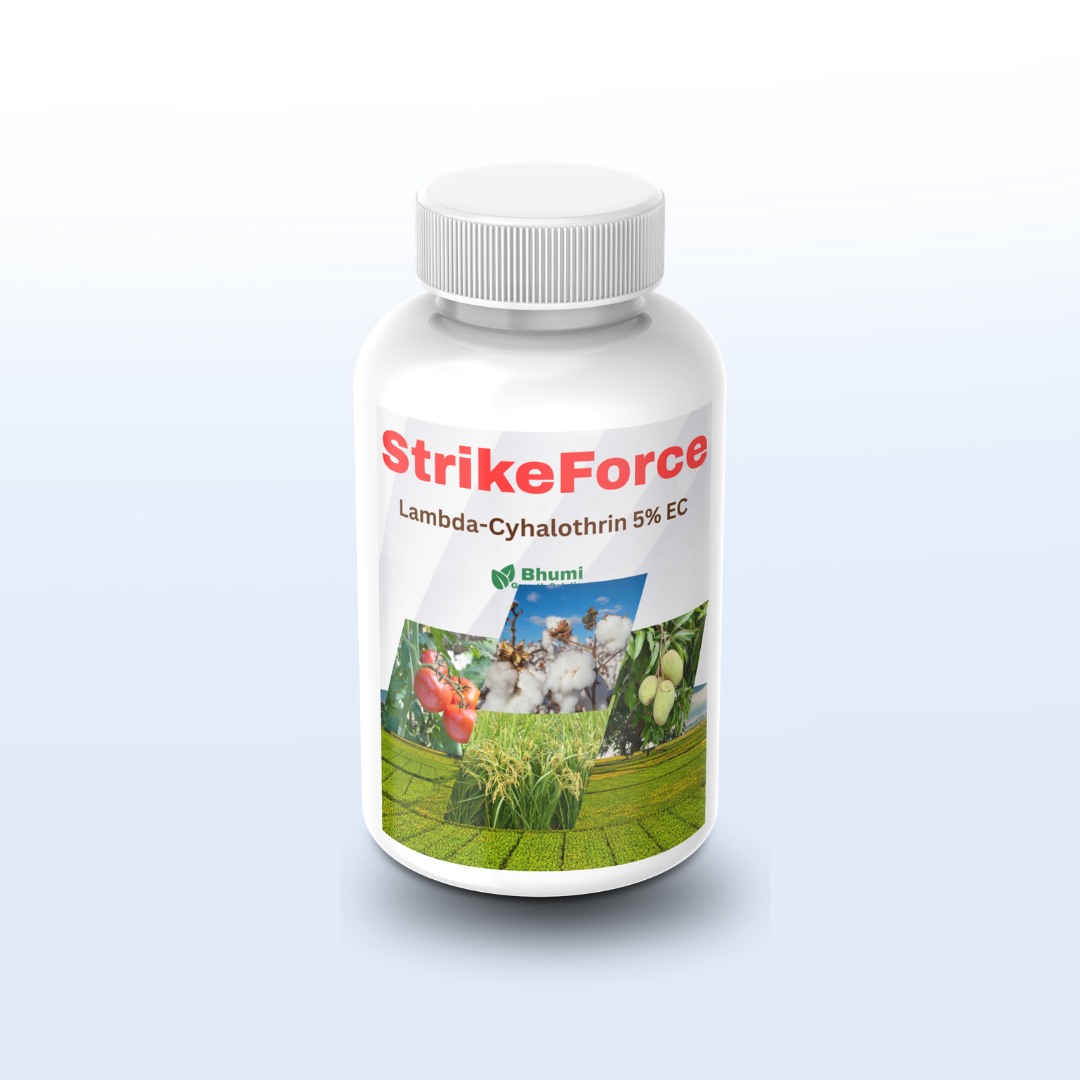
What is StrikeForce?
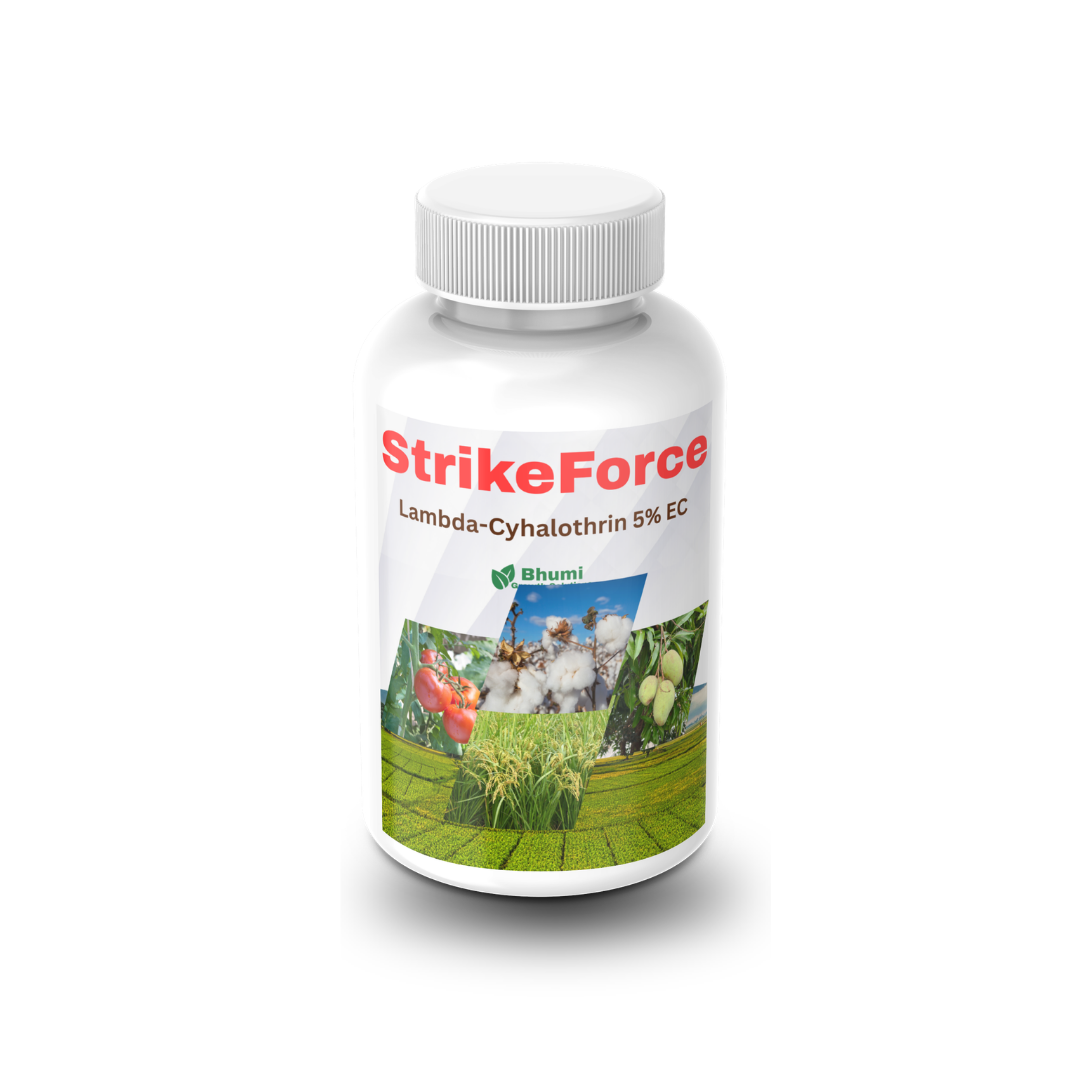
StrikeForce is Bhumi Growth Solutions’ professional-grade Lambda-Cyhalothrin 5% w/v Emulsifiable Concentrate (EC) insecticide — a highly effective, broad-spectrum synthetic pyrethroid with a long and proven track record in Indian agriculture. Lambda-Cyhalothrin 5% EC is one of the most widely registered and used insecticide formulations in India, with decades of documented field performance across cotton, paddy, vegetables, pulses, fruit crops, and plantation crops.
StrikeForce works through the classic, proven EC (Emulsifiable Concentrate) mechanism — the active ingredient is dissolved in a blend of organic solvents and emulsifying agents that, when diluted in water, form a uniform, stable milky-white emulsion. This emulsion delivers full, direct-release contact with the active ingredient onto pest surfaces and plant tissues — giving StrikeForce its characteristic rapid, visible knockdown effect that farmers can observe within minutes to hours of application.
As an IRAC Group 3A Pyrethroid — completely different from IRAC Group 4A Neonicotinoids (IMIDA-178, IMIDA Max-305, SAFAYA-70) — StrikeForce is the ideal rotation partner for managing resistance in sucking pest populations, while simultaneously providing highly effective control of chewing pests, boring insects, and caterpillars that neonicotinoids alone cannot fully manage.
Understanding the EC Formulation: StrikeForce vs LAMBDORA
Bhumi Growth Solutions offers two Lambda-Cyhalothrin formulations — StrikeForce (5% EC) and LAMBDORA (4.9% CS). Understanding the difference helps farmers choose the right tool for their specific conditions:
| Parameter | StrikeForce (5% EC) | LAMBDORA (4.9% CS) |
| Active Ingredient | Lambda-Cyhalothrin 5% EC | Lambda-Cyhalothrin 4.9% CS |
| AI Concentration | 5% w/v (slightly higher) | 4.9% w/v |
| Formulation Technology | Emulsifiable Concentrate (traditional) | Capsule Suspension (microencapsulated) |
| Release Mechanism | Immediate, direct-release on contact | Triggered release from capsule disruption |
| Initial Knockdown Speed | Slightly faster (direct AI release) | Fast (capsule burst on contact) |
| Residual Activity | 14 days (moderate) | Up to 21 days (extended — capsule slow release) |
| Phytotoxicity Risk | Moderate (EC solvents can stress sensitive crops in heat) | Lower (no solvents — water-based carrier) |
| Handling Safety | Standard PPE required | Safer (encapsulated AI) |
| Rain Fastness | Moderate | Superior (capsules adhere better) |
| Cost Economics | More economical — proven, cost-effective choice | Premium — advanced technology at higher cost |
| Best For | Economical commercial use, fast-response sprays | Long-residual, sensitive crops, hot conditions |
| Water Mix Appearance | Milky white emulsion | Milky white suspension |
How Does StrikeForce Work? (Mode of Action)
StrikeForce operates through the same well-documented IRAC Group 3A mechanism as LAMBDORA, with the key characteristic that the EC formulation provides immediate, full-release activity from the moment of pest contact:
- Emulsification & Direct Contact: When StrikeForce is mixed with water, it forms a stable emulsion where Lambda-Cyhalothrin molecules are uniformly distributed throughout the spray solution. Upon application, these molecules make immediate, direct contact with insect cuticle and plant surfaces — with no capsule barrier to slow the initial release.
- Rapid Cuticular Absorption: Lambda-Cyhalothrin from the EC formulation is highly lipophilic (fat-soluble) and penetrates the insect cuticle (waxy exoskeleton) extremely rapidly, entering the nervous system within minutes of contact. This gives StrikeForce its characteristically fast initial knockdown speed.
- Voltage-Gated Sodium Channel Binding: Once inside the insect’s nervous system, Lambda-Cyhalothrin binds to voltage-gated sodium channels in nerve axon membranes, holding them permanently open. Under normal physiology, these channels open and close rapidly during nerve impulses; pyrethroid binding prevents closure.
- Continuous Nerve Firing → Paralysis: The held-open sodium channels cause uncontrolled, continuous sodium ion influx into nerve cells — triggering uncontrolled, repetitive nerve firing throughout the insect’s nervous system. This causes rapid hyperexcitation, visible tremors and uncoordinated movement (knockdown), progressive paralysis, and death.
- Stomach Action: Insects that ingest Lambda-Cyhalothrin through feeding on treated plant tissue absorb it through the gut lining — triggering the same neurological cascade. This provides an additional layer of pest control for chewing and boring insects that are not killed by direct contact.
- Repellent & Anti-Feeding Effect: Lambda-Cyhalothrin has a documented repellent and feeding deterrent effect — insects detect the chemical on treated surfaces and avoid feeding, laying eggs, or congregating on treated crop surfaces. This sub-lethal effect reduces crop damage and pest-transmitted virus spread, even from insects that are not killed outright.
Target Pests
| Target Pest (Scientific Name / Common Name) | Key Crop(s) |
| Bollworms (Helicoverpa armigera, Pectinophora gossypiella, Earias spp.) | Cotton |
| Jassids / Leafhoppers (Amrasca biguttula) | Cotton, Okra, Brinjal |
| Thrips (Thrips tabaci, Scirtothrips dorsalis) | Cotton, Chilli, Onion, Groundnut |
| Leaf Folder (Cnaphalocrocis medinalis) | Rice / Paddy |
| Stem Borer (Chilo partellus, Scirpophaga spp.) | Rice / Paddy |
| Green Leaf Hopper / GLH (Nephotettix virescens) | Rice / Paddy |
| Gall Midge (Orseolia oryzae) | Rice / Paddy |
| Hispa (Dicladispa armigera) | Rice / Paddy |
| Whorl Maggot (Hydrellia philippina) | Rice / Paddy |
| Fruit & Shoot Borer (Leucinodes orbonalis) | Brinjal |
| Fruit Borer (Helicoverpa armigera) | Tomato |
| Thrips, Mites, Pod Borer | Chilli |
| Pod Borer, Pod Fly (Maruca vitrata, Melanagromyza chalcosoma) | Pigeonpea |
| Thrips (Thrips tabaci) | Onion |
| Jassids, Shoot Borer | Okra / Bhindi |
| Pod Borer (Helicoverpa armigera) | Chickpea |
| Thrips, Leaf Hopper, Leaf Miner | Groundnut |
| Hopper (Idioscopus spp.) | Mango |
| Flea Beetle, Thrips | Grapes |
| Aphids | Cotton, Chilli, Vegetables |
CIB-Verified Crop-Wise Dosage & Application Table
| Crop | Target Pests | Method | Dose/Acre | Water/Acre | Dilution Rate | PHI (Days) |
| Cotton | Bollworms, Jassids, Thrips | Foliar Spray | 120–200 ml | 160–240 L | 1.5–2 ml/L | 21 days |
| Rice / Paddy | Leaf Folder, Stem Borer, GLH, Gall Midge, Hispa, Thrips | Foliar Spray | 100–125 ml | 200 L | 1.5–2 ml/L | As per label |
| Brinjal | Fruit & Shoot Borer | Foliar Spray | 100–120 ml | 200 L | 1.5 ml/L | As per label |
| Okra / Bhindi | Jassids, Shoot Borer | Foliar Spray | 120 ml | 120–160 L | 1.5 ml/L | 4 days |
| Chilli | Thrips, Mites, Pod Borer | Foliar Spray | 100–120 ml | 200 L | 1.5 ml/L | 5 days |
| Tomato | Fruit Borer | Foliar Spray | 100–120 ml | 200 L | 1.5 ml/L | As per label |
| Pigeonpea | Pod Borer, Pod Fly | Foliar Spray | 100–120 ml | 200 L | 1.5 ml/L | As per label |
| Onion | Thrips | Foliar Spray | 100 ml | 200 L | 1.5 ml/L | As per label |
| Chickpea | Pod Borer | Foliar Spray | 200 ml | 120–160 L | 1.5–2 ml/L | 6 days |
| Groundnut | Thrips, Leaf Hopper, Leaf Miner | Foliar Spray | 80–120 ml | 160–200 L | 1 ml/L | 10 days |
| Mango | Hopper | Foliar Spray | 0.5–1 ml/L water | As required | 0.5–1 ml/L | As per label |
| Grapes | Flea Beetle, Thrips | Foliar Spray | 100 ml | 200–400 L | 0.5–1 ml/L | 7 days |
💡 QUICK REFERENCE:
• 15-litre knapsack pump: 30 ml per pump (2 ml per litre)
• Per acre general: 300 ml in 200 litres of water
• Home/kitchen garden: 1–2 ml per litre of water
How to Prepare StrikeForce Spray Solution
- Step 1: Measure the required quantity of StrikeForce accurately using a graduated measuring cylinder
- Step 2: Fill the spray tank half-full with clean water (pH 5.5–7.0 preferred)
- Step 3: Add the measured StrikeForce to the water — it forms a uniform milky white emulsion; stir gently
- Step 4: Top up with the remaining water and agitate to ensure a uniform, stable emulsion throughout the tank
- Step 5: Begin spraying immediately — maintain gentle agitation during application to keep the emulsion stable
- Step 6: Spray thoroughly to cover both upper and lower leaf surfaces, fruiting bodies, and growing shoots
- Step 7: For Rice stem borer and leaf folder control, direct the spray nozzle toward the base of the plant canopy and rolled leaves
- Step 8: For Mango hopper, spray at flush and pre-flowering stages, covering undersides of new growth thoroughly
- Step 9: Wash spray equipment thoroughly with soap and water after use
Application Tips for Best Results
- Apply at the FIRST sign of pest infestation or egg hatching — early-instar larvae and nymphs are far more susceptible to pyrethroids than mature insects
- Spray in early morning (6–9 AM) or late evening (after 5 PM) — UV radiation accelerates EC pyrethroid degradation; avoid midday heat spraying which increases phytotoxicity risk from EC solvents
- Do NOT apply in temperatures above 35°C — EC formulation solvents can cause leaf burn on sensitive crops in extreme heat; use LAMBDORA CS in hot, summer conditions
- Do NOT mix with alkaline products (lime, copper oxychloride, Bordeaux mixture) — pyrethroids degrade rapidly at high pH
- For cotton bollworm management: Rotate StrikeForce with IMIDA-178 (IRAC Group 4A) — 2 sprays of each group per season prevents resistance buildup
- Observe PHI strictly — especially for short-cycle vegetables: Okra (4 days), Chickpea (6 days), Groundnut (10 days)
- For home/kitchen garden use: 1–2 ml per litre is safe and effective for all vegetables and fruit plants
IPM Rotation Programme with Bhumi Growth Solutions Range
🔄 COMPLETE BHUMI IPM ROTATION — IRAC Group 4A → 3A → Bio-Pesticide:
Spray 1–2: IMIDA-178 / IMIDA Max-305 / SAFAYA-70 (IRAC Group 4A — Neonicotinoid)
→ Controls: Aphids, Whiteflies, Thrips, Jassids, BPH, WBPH
Spray 3–4: StrikeForce (IRAC Group 3A — Pyrethroid EC)
OR LAMBDORA (IRAC Group 3A — Pyrethroid CS for longer residual)
→ Controls: Bollworms, Caterpillars, Borers, Thrips, Aphids, Jassids
Optional Spray 5: NEEMOLI-15 (Bio-Pesticide — Azadirachtin 1500 PPM)
→ Organic rotation option — controls sucking + chewing pests
→ No resistance development risk; enhances beneficial insect populations
✅ This 3-group rotation provides season-long pest control with ZERO resistance risk
Key Benefits at a Glance
- ✅ IRAC Group 3A Pyrethroid — Perfect rotation partner for Imidacloprid (Group 4A) products
- ✅ Lightning-Fast Knockdown — Direct EC release; pest immobilisation within minutes of contact
- ✅ 14+ Day Residual Activity — Adequate long-lasting protection per spray application
- ✅ Broadest Multi-Crop Registration — 12+ major crops on CIB-registered label
- ✅ Repellent + Contact + Stomach — Triple action including feeding deterrence
- ✅ Protects Against Virus Spread — Feeding inhibition stops whitefly/aphid-transmitted viruses
- ✅ Economical EC Formulation — More affordable per litre vs CS; value choice for commercial farmers
- ✅ Versatile Application — Foliar spray for field crops, orchards, vegetables, and home gardens
- ✅ Short PHI for Quick-Harvest Crops — 4 days for Okra; suitable for fast-turnover vegetable cultivation
- ✅ Available in Custom Sizes — 100 ml to bulk quantities for every farm size and budget
Available Pack Sizes
Standard Size: 1 Litre
Custom Sizes: 100 ml | 250 ml | 500 ml | 1 Litre | Bulk quantities
Safety, Precautions & First Aid
- Always wear full PPE: chemical-resistant gloves, protective goggles, full-sleeve clothing, and nose-mouth mask during mixing and spraying
- Pyrethroids cause paresthesia (tingling/burning skin sensation) on exposure — wash immediately with soap and water; apply baby oil or vitamin E cream to affected skin
- Store in original tightly sealed container in a cool, dry, locked location away from children, food, and water sources
- DO NOT spray near water bodies — Lambda-Cyhalothrin EC is HIGHLY TOXIC to fish, aquatic organisms, and honeybees
- DO NOT spray on flowers during bee activity hours — spray only in early morning or late evening to protect pollinators
- If skin contact: Immediately remove clothing; wash skin with soap and water for at least 15 minutes
- If eye contact: Immediately flush with clean running water for 15–20 minutes; consult ophthalmologist
- If inhaled: Move to fresh air; seek immediate medical attention if breathing difficulty persists
- If ingested: Do NOT induce vomiting; seek immediate emergency medical care; show label to physician
- No specific antidote — supportive/symptomatic treatment; atropine NOT required
- Triple-rinse empty containers; never reuse for food or domestic storage
Frequently Asked Questions (FAQs)
Q1. What is the difference between StrikeForce (5% EC) and LAMBDORA (4.9% CS)?
StrikeForce uses a traditional EC (Emulsifiable Concentrate) formulation where Lambda-Cyhalothrin is dissolved in organic solvents. LAMBDORA uses advanced CS (Capsule Suspension) microencapsulation. StrikeForce provides slightly faster initial knockdown and is more economical. LAMBDORA offers extended residual activity (up to 21 days vs 14 days), lower phytotoxicity risk, better rain fastness, and safer handling. Both target the same pest spectrum.
Q2. What pests and crops does StrikeForce cover?
StrikeForce controls Bollworms, Caterpillars, Leaf Folders, Stem Borers, Gall Midges, Hispa, Fruit Borers, Pod Borers, Thrips, Jassids, Aphids, Mango Hoppers, Flea Beetles, and more — across Cotton, Rice, Brinjal, Okra, Chilli, Tomato, Pigeonpea, Onion, Chickpea, Groundnut, Mango, and Grapes.
Q3. What is the correct dose of StrikeForce per acre?
Cotton (Bollworms, Jassids, Thrips): 120–200 ml/acre in 160–240 L water. Rice/Paddy: 100–125 ml/acre. Okra/Bhindi (PHI 4 days): 120 ml/acre. Chilli: 100–120 ml/acre. Chickpea: 200 ml/acre. General use: 30 ml per 15-litre pump or 300 ml per acre. Source: CIB-registered product labels for Lambda-Cyhalothrin 5% EC.
Q4. Why is it important to rotate StrikeForce with IMIDA-178 or IMIDA Max-305?
StrikeForce (IRAC Group 3A — Pyrethroid) and IMIDA-178/Max-305/SAFAYA-70 (IRAC Group 4A — Neonicotinoid) have completely different modes of action. Rotating between these two groups prevents the development of resistance in pest populations — which would occur if the same IRAC group is used for all sprays in a season. The recommendation is maximum 2 consecutive applications of any single IRAC group before rotating.
Q5. What is the pre-harvest interval (PHI) for StrikeForce?
PHI varies by crop: Cotton (21 days), Okra/Bhindi (4 days — very short PHI), Chickpea (6 days), Groundnut (10 days), Chilli (5 days), Grapes (7 days). The 4-day PHI on Okra makes StrikeForce particularly suitable for fast-turnover vegetable cultivation.
Q6. Is StrikeForce safe near water bodies and bees?
No. Lambda-Cyhalothrin 5% EC is HIGHLY TOXIC to fish, aquatic invertebrates, and honeybees. Never apply near water bodies (ponds, rivers, irrigation canals). Never spray on flowering crops during peak bee foraging hours. Always spray in early morning or late evening to minimise bee exposure.
Q7. Can StrikeForce be used for home gardens and kitchen gardens?
Yes. StrikeForce is suitable for home and kitchen garden use at a dilution of 1–2 ml per litre of water. It can be used on vegetables, fruit trees, and ornamentals for broad-spectrum insect control. Always observe the PHI for edible crops before harvesting and use full PPE during application.


Reviews
There are no reviews yet.