



Description
What is Professor 50?
Professor 50 is a high-concentration Profenophos 50% w/v EC (Emulsifiable Concentrate) insecticide from Bhumi Growth Solutions — formulated with the maximum commercially available concentration of Profenophos as a single active ingredient. As an IRAC Group 1B Organophosphate, Professor 50 works through a completely different biochemical pathway from pyrethroid insecticides (IRAC Group 3A) — making it an essential tool for Integrated Pest Management (IPM) programmes where pyrethroid-resistant pest populations are present, or where independent IRAC group rotation is required.
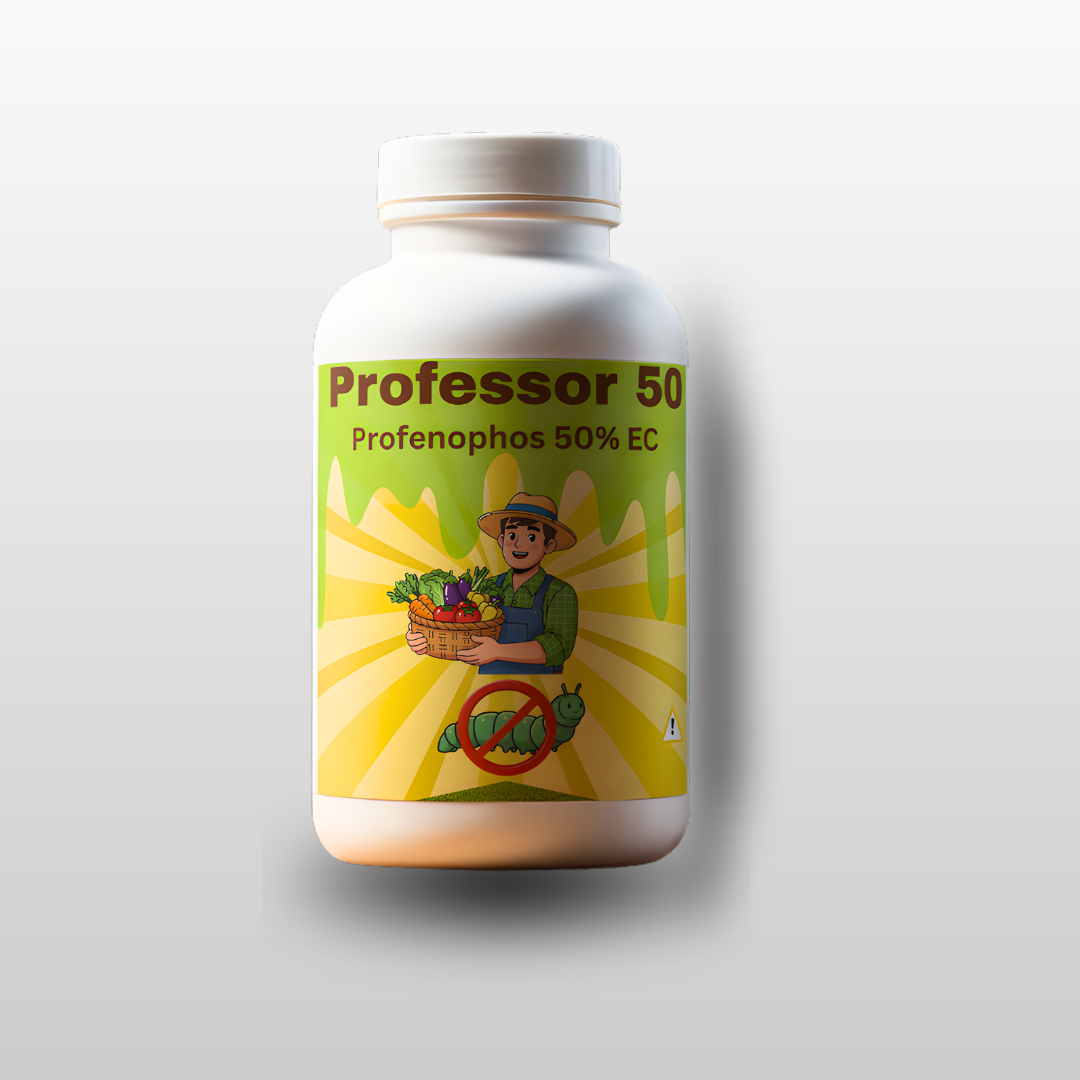
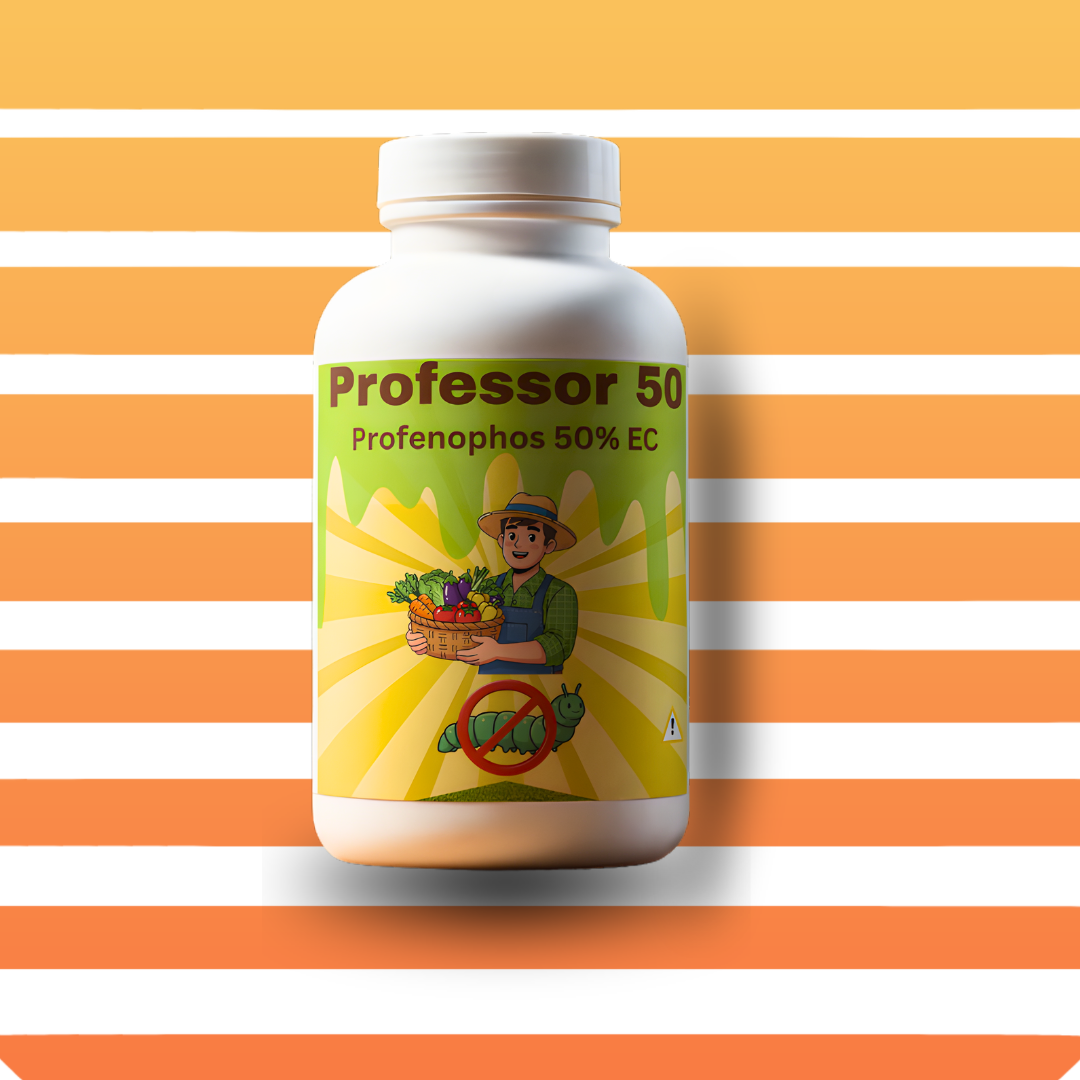
Profenophos is one of the most extensively registered and widely used organophosphate active ingredients in Indian commercial agriculture — with a particularly strong track record against the full Bollworm complex in Cotton (India’s most economically important crop for insecticide use), and against Fruit Borers and Sucking Pests in vegetable crops. The label visual of a farmer proudly holding a basket of healthy vegetables — tomato, carrot, brinjal, capsicum, potato — alongside a “no caterpillar” symbol directly communicates Professor 50’s primary positioning: protecting vegetable crops from chewing, boring, and sucking pest damage.
At 50% concentration — 25% higher than the 40% Profenofos in Profex Duo — Professor 50 delivers maximum Profenofos loading per litre of formulation, providing more active ingredient per spray for the most challenging pest infestation scenarios, particularly during peak bollworm pressure in Cotton.
Understanding Profenophos: The Organophosphate with Unique Properties
Profenophos stands apart from other Organophosphates (OPs) due to a specific combination of properties that makes it particularly valuable in Indian crop protection:
- High Lipophilicity → Translaminar Action: Unlike many OPs that remain on the leaf surface, Profenophos’s high lipophilicity (fat-solubility) allows it to penetrate through leaf cuticle and translocate within the leaf blade. It moves from the sprayed upper surface to the unsprayed lower surface — reaching leaf-feeding pests hiding on undersides, inside rolled leaves, and within developing fruits and bolls.
- Ovicidal Activity: Profenophos penetrates and disrupts egg development — killing insect eggs deposited on treated leaf surfaces and on leaf undersides. This ovicidal property is critically important for breaking the bollworm breeding cycle: Helicoverpa armigera alone can lay up to 1,000 eggs per female; destroying eggs before they hatch prevents the next generation of crop-damaging larvae from ever establishing.
- Contact + Stomach + Systemic: Professor 50 acts through direct cuticle contact, through ingestion of treated plant tissue, and through systemic movement within the vascular system of the plant — covering all three major routes of insecticidal entry to provide complete pest management coverage.
- Broad Spectrum: Unlike some OPs that have narrow target ranges, Profenophos 50% EC has broad-spectrum activity covering both chewing pests (bollworms, caterpillars, borers) AND sucking pests (jassids, aphids, thrips, whiteflies) — making it a versatile single-product solution for mixed-pest infestations, especially in Cotton.
- Non-Systemic to Plant (Translaminar Only): An important distinction: Professor 50 is translaminar (penetrates within the leaf), but is NOT truly phloem-systemic like neonicotinoids. It does not travel from leaf to root or from old leaves to new growth. This means application must cover all actively infested plant parts, and each new crop flush after spraying requires a fresh application for continued protection.
How Does Professor 50 Work? (Mode of Action)
- Contact Uptake: When an insect contacts a Professor 50-treated leaf surface, Profenophos is rapidly absorbed through the insect’s cuticle (waxy exoskeleton) and enters the haemolymph (insect circulatory fluid), from where it reaches nerve junctions throughout the body.
- Stomach Action: Insects that feed on Professor 50-treated plant tissue ingest Profenophos, which is then absorbed across the gut wall. This provides additional control of insects that land on treated surfaces but may not be directly contacted by the spray droplets.
- Acetylcholinesterase (AChE) Inhibition: Profenophos’s primary mode of action is irreversible inhibition of acetylcholinesterase — the enzyme at nerve synapses responsible for breaking down the neurotransmitter acetylcholine (ACh) after each nerve impulse. By blocking AChE, Profenophos causes ACh to accumulate continuously at nerve junctions, producing uncontrolled, sustained nerve excitation throughout the insect’s nervous system.
- Cholinergic Crisis → Paralysis → Death: The ACh accumulation causes a “cholinergic crisis” — uncontrolled muscle contractions, excessive secretions (salivation, lacrimation in mammals — tremors and twitching in insects), progressive paralysis of motor and respiratory muscles, and ultimately death from respiratory failure. The entire process from contact to death typically occurs within 1–4 hours, depending on insect species and instar.
- Translaminar Movement & Egg Kill: After spraying, Profenophos diffuses through the leaf epidermis and mesophyll tissue — making it available to pests feeding inside rolled leaves, within leaf tissue (leaf miners), and on the unsprayed lower surface. On contact with insect eggs, Profenophos disrupts embryonic development and kills eggs within 24–48 hours of application.
When to Choose Professor 50 vs Profex Duo
| Parameter | Professor 50 (50% EC) | Profex Duo (40%+4% EC) |
| Active Ingredient(s) | Profenofos 50% (single active) | Profenofos 40% + Cypermethrin 4% |
| Profenofos Concentration | 50% w/v — maximum concentration | 40% w/v |
| IRAC Group(s) | Group 1B only | Group 1B + Group 3A (dual) |
| Knockdown Speed | Moderate (systemic/contact) | Very fast (Cypermethrin rapid knockdown) |
| Systemic Action | Full systemic + translaminar | Systemic + translaminar (Profenofos component) |
| Ovicidal Activity | Yes (Profenofos 50%) | Yes (Profenofos 40%) |
| Repellent Effect | None (OPs are non-repellent) | Yes (Cypermethrin component) |
| Resistance Strategy | Single IRAC 1B — use when Group 3A resistance present | Dual IRAC 1B+3A — broadest in-spray coverage |
| Best Use Case | Heavy bollworm infestations; pyrethroid-resistant populations; pure OP rotation | Mixed chewing + sucking pest pressure; when fast knockdown is critical |
| Cost Economics | Higher AI loading per spray | Dual-action value per spray |
Target Pests
| Target Pest (Scientific Name) | Key Crop(s) |
| American Bollworm (Helicoverpa armigera) | Cotton — primary target; also Chickpea, Tomato, Chilli |
| Pink Bollworm (Pectinophora gossypiella) | Cotton |
| Spotted Bollworm (Earias vittella) | Cotton |
| Tobacco Caterpillar / Semilooper (Spodoptera litura, Chrysodeixis acuta) | Cotton, Soybean, Groundnut |
| Girdle Beetle (Obereopsis brevis) | Soybean — specific borer pest |
| Fruit & Shoot Borer (Leucinodes orbonalis) | Brinjal |
| Fruit Borer (Earias spp., Helicoverpa) | Okra, Tomato |
| Jassids / Leafhoppers (Amrasca biguttula) | Cotton, Okra, Brinjal |
| Aphids (Aphis gossypii) | Cotton, Vegetables |
| Thrips (Thrips tabaci) | Cotton, Chilli, Onion |
| Whiteflies (Bemisia tabaci) | Cotton, Tomato, Chilli |
| Leaf Miner | Tomato, Vegetables |
| Mites (Tetranychus urticae) | Cotton, Brinjal, Vegetables |
| Mealy Bugs | Cotton, Sugarcane |
CIB-Verified Crop-Wise Dosage & Application Table
⚠️ RESTRICTED IN KERALA STATE — Do not sell or ship to Kerala.
| Crop | Target Pests | Method | Dose/Acre | Water/Acre | Dilution Rate | PHI (Days) |
| Cotton | Bollworm complex (American, Pink, Spotted) | Foliar Spray | 600–800 ml | 200–400 L | 1.5–2 ml/L | 15 days |
| Cotton | Jassids, Aphids, Thrips, Whiteflies | Foliar Spray | 400 ml | 200–400 L | 1.5–2 ml/L | 15 days |
| Soybean | Semilooper, Girdle Beetle | Foliar Spray | 300–320 ml | 200 L | 1.5 ml/L | 40 days |
| Brinjal | Fruit & Shoot Borer, Jassids, Aphids | Foliar Spray | 400 ml | 200 L | 2 ml/L | 7 days |
| Okra / Bhindi | Fruit Borer, Whitefly, Leaf Hopper, Jassids | Foliar Spray | 400 ml | 200 L | 2 ml/L | 7 days |
| Chilli | Thrips, Fruit Borer | Foliar Spray | 400 ml | 200 L | 2 ml/L | 5 days |
| Tomato | Fruit Borer, Leaf Miner, Aphids | Foliar Spray | 400 ml | 200 L | 2 ml/L | As per label |
| Chickpea / Gram | Gram Pod Borer (Helicoverpa) | Foliar Spray | 400–500 ml | 200 L | 2 ml/L | As per label |
| Pulses (General) | Pod Borer, Caterpillars | Foliar Spray | 400 ml | 200 L | 2 ml/L | As per label |
| Sugarcane | Mealy Bug | Foliar + Soil drench | 400–500 ml | 200 L | 2 ml/L | As per label |
| Rice / Paddy | Leaf Folder, Stem Borer | Foliar Spray | 400 ml | 200 L | 2 ml/L | As per label |
💡 QUICK REFERENCE:
• Per 15-litre knapsack pump: 35–40 ml per pump
• Per acre general: 400–500 ml in 200 litres of water
• General dilution: 1.5–2 ml per litre of water
• Maximum recommended sprays per crop season: 2 applications
How to Prepare Professor 50 Spray Solution
- Step 1: Wear full PPE before handling — gloves, goggles, full-sleeve clothing, and mask are essential for Organophosphate products
- Step 2: Shake the Professor 50 bottle well before measuring — the EC formulation may separate slightly during storage
- Step 3: Measure the required quantity accurately using a graduated measuring cylinder
- Step 4: Fill the spray tank half-full with clean water (pH 6.0–7.0 preferred; alkaline water degrades Profenophos rapidly)
- Step 5: Add the measured Professor 50 to the water while stirring gently — it forms a stable milky-brown emulsion
- Step 6: Top up with the remaining water and agitate the spray tank to ensure uniform distribution
- Step 7: Begin spraying immediately — direct the nozzle to ensure coverage of both upper and lower leaf surfaces
- Step 8: For Cotton bollworm: Focus spray on squares, bolls, and fruiting branches where larvae bore and feed
- Step 9: For vegetable crops: Cover all plant parts thoroughly including stems, leaf undersides, and developing fruits
- Step 10: Wash all spray equipment and PPE thoroughly with soap and water after use; dispose of wash water safely away from water bodies
Application Tips for Best Results
- Apply at FIRST DETECTION of bollworm eggs or early first-instar larvae (young caterpillars just hatched) — Profenophos is most effective against early instars and eggs; mature bollworms are significantly more tolerant
- Spray in early morning (6–9 AM) or late evening — UV radiation degrades Profenophos on leaf surfaces; avoid midday spraying in temperatures above 35°C
- Do NOT mix with alkaline compounds (lime, Bordeaux mixture, copper oxychloride) — Profenophos undergoes rapid alkaline hydrolysis (chemical breakdown) under high pH conditions
- Professor 50 is best used in ALTERNATION with IRAC Group 3A products (StrikeForce, LAMBDORA) — use 1–2 sprays of Professor 50, then switch to pyrethroid for next application cycle
- Observe the PHI strictly — 15 days for Cotton (CIB-registered PHI); 40 days for Soybean; 7 days for vegetables; 5 days for Chilli
- Recommended maximum: 2 applications per crop season — do not exceed to minimise residue accumulation and resistance risk
- For Soybean Girdle Beetle: Apply when adult beetles are actively girdling stems — target the adults before oviposition (egg-laying)
- Home/kitchen garden use: 1.5–2 ml per litre of water for vegetables; strictly observe PHI before harvest
IPM Strategy: Professor 50’s Role in the Bhumi Rotation Programme
🔄 RECOMMENDED BHUMI IPM ROTATION USING PROFESSOR 50:
Spray 1 (IRAC Group 4A — Neonicotinoid): IMIDA-178 / IMIDA Max-305 / SAFAYA-70
→ Controls: Aphids, Whiteflies, Thrips, Jassids, BPH
Spray 2 (IRAC Group 1B+3A — Combination): Profex Duo (Profenofos 40% + Cypermethrin 4%)
→ Controls: Bollworms, Caterpillars, Borers + Sucking pests (dual-action)
Spray 3 (IRAC Group 1B — Single Active): Professor 50 (Profenofos 50% EC)
→ Pure systemic/translaminar — maximum ovicidal + borer kill
Spray 4 (IRAC Group 3A — Pyrethroid): StrikeForce / LAMBDORA
→ Contact knockdown + repellent rotation
✅ This 4-IRAC-group rotation provides maximum resistance prevention across the full season
Key Benefits at a Glance
- ✅ Maximum Profenofos Concentration — 50% w/v — highest available for single-active Profenofos EC
- ✅ IRAC Group 1B — Pure Organophosphate — clean single-group rotation tool
- ✅ Five-Way Pest Action — Contact + Stomach + Systemic + Translaminar + Ovicidal
- ✅ Ovicidal Activity — Destroys insect eggs; breaks pest breeding cycle before damage begins
- ✅ Translaminar Penetration — Kills hidden borers, leaf miners, and underside-feeding pests
- ✅ Broad-Spectrum — Bollworms, caterpillars, borers, jassids, aphids, thrips, whiteflies, mites
- ✅ Multi-Crop Registration — Cotton, Soybean, Brinjal, Okra, Chilli, Tomato, Rice, Pulses, Sugarcane
- ✅ Short PHI for Vegetables — 7 days Okra/Brinjal; 5 days Chilli; suitable for commercial vegetable cultivation
- ✅ Pyrethroid Resistance Tool — Pure IRAC 1B bypasses Group 3A resistance in populations
- ✅ Custom Pack Sizes — 100 ml to bulk quantities for every farm and distributor requirement
Available Pack Sizes
Standard Size: 1 Litre
Custom Sizes: 100 ml | 250 ml | 500 ml | 1 Litre | Bulk quantities
Safety, Precautions & First Aid
⚠️ IMPORTANT: Professor 50 contains Profenophos — an Organophosphate.
Organophosphates inhibit acetylcholinesterase in humans and animals at toxic doses.
Strict PPE use and safe handling protocols are MANDATORY. Product carries a CAUTION WARNING symbol.
- ALWAYS wear full PPE: chemical-resistant gloves, protective goggles, full-sleeve clothing, nose-mouth respirator mask — mandatory for all Organophosphate products including Professor 50
- Do NOT eat, drink, or smoke during handling, mixing, or application; wash hands and face before eating after use
- Store in original, tightly sealed container in a cool (below 30°C), dry, well-ventilated, locked location away from children, food, water sources, and animal feed
- DO NOT spray near water bodies (ponds, rivers, irrigation canals) — Profenophos is moderately to highly toxic to fish and aquatic organisms
- DO NOT spray on flowering crops during bee activity hours — Profenophos is toxic to honeybees at field application rates
- If skin contact: Immediately remove contaminated clothing; wash exposed skin thoroughly with soap and plenty of water for at least 15–20 minutes
- If eye contact: Immediately and continuously flush with clean running water for at least 15–20 minutes; consult an ophthalmologist
- If inhaled: Move immediately to fresh air; if breathing difficulty, coughing, or dizziness occurs — seek immediate emergency medical attention
- If ingested: Do NOT induce vomiting; keep the patient calm and at rest; seek IMMEDIATE emergency medical care; bring the product label or SDS to the physician
- ANTIDOTE: Atropine sulphate (physician-directed dose) is the specific antidote for organophosphate poisoning; pralidoxime (2-PAM) may be indicated in acute poisoning — administer ONLY under qualified medical supervision in hospital setting
- No more than 2 applications per crop season; strictly observe Pre-Harvest Interval (PHI) for each crop
- Triple-rinse empty containers before disposal; never reuse containers for food, water, or domestic storage
- ⚠️ RESTRICTED IN KERALA STATE — Do NOT sell, distribute, or use in Kerala
Frequently Asked Questions (FAQs)
Q1. What is the difference between Professor 50 and Profex Duo?
Professor 50 contains a single active ingredient — Profenophos 50% EC (pure IRAC Group 1B organophosphate). Profex Duo combines Profenofos 40% + Cypermethrin 4% (IRAC Group 1B + 3A dual action). Professor 50 is ideal for: (a) maximum systemic/translaminar action, (b) when pyrethroid resistance is present and a clean IRAC 1B spray is needed, and (c) when ovicidal activity is the primary requirement. Profex Duo is ideal for: mixed bollworm + sucking pest pressure and when fast Cypermethrin knockdown is needed alongside systemic action.
Q2. What is translaminar action and why is it important?
Translaminar action means the insecticide penetrates through the leaf from the sprayed surface (usually upper) to the unsprayed surface (usually lower). This is critically important because many pests — including Fruit & Shoot Borers, Leaf Miners, and most sucking insects (aphids, jassids, whiteflies) — feed on the underside of leaves and would not be contacted by a surface-only spray. Professor 50’s Profenophos component penetrates through leaf tissue, making it effective against all these hidden, hard-to-reach pests.
Q3. What is the dosage of Professor 50 per acre?
Cotton (Bollworm): 600–800 ml/acre in 200–400 L water. Cotton (Jassids, Thrips, Aphids, Whiteflies): 400 ml/acre. Soybean (Semilooper, Girdle Beetle): 300–320 ml/acre. Brinjal, Okra (Fruit Borer): 400 ml/acre. Chilli: 400 ml/acre. General dilution: 35–40 ml per 15-litre pump; 1.5–2 ml per litre of water. Source: Multiple CIB-registered Profenofos 50% EC product labels.
Q4. What is the pre-harvest interval (PHI) for Professor 50?
Cotton: 15 days. Soybean: 40 days. Okra/Bhindi: 7 days. Chilli: 5 days. Strictly observe PHI to ensure produce safety and compliance with MRLs. Professor 50’s 7-day PHI for Okra and 5-day PHI for Chilli make it suitable for regular-harvest vegetable cultivation.
Q5. How many times can Professor 50 be applied in one season?
Maximum 2 applications per crop season is recommended for Profenofos 50% EC. This limit is important for: (a) preventing residue accumulation above MRLs, (b) minimising resistance development pressure, and (c) protecting non-target organisms including soil microbiota. After 2 applications, rotate to a different IRAC group product — StrikeForce or LAMBDORA (IRAC 3A).
Q6. Is Professor 50 available in Kerala?
No. Professor 50 (Profenofos 50% EC) is RESTRICTED FOR SALE AND USE IN KERALA STATE. We do not supply or ship this product to Kerala. Customers in Kerala can use NEEMOLI-15 (Bio-Pesticide), LAMBDORA, or StrikeForce as alternatives for caterpillar and pest management.
Q7. Can Professor 50 be used in home gardens and kitchen gardens?
Yes, with strict precautions. Use at 1.5–2 ml per litre of water for vegetables, fruit trees, and ornamentals. Always wear full PPE during preparation and spraying. Strictly observe PHI before harvesting edible crops. Do not exceed 2 applications per season. Keep children and pets away from the spraying area and recently sprayed plants for at least 24–48 hours.


Reviews
There are no reviews yet.