


Description
What is Thiamax-FS?
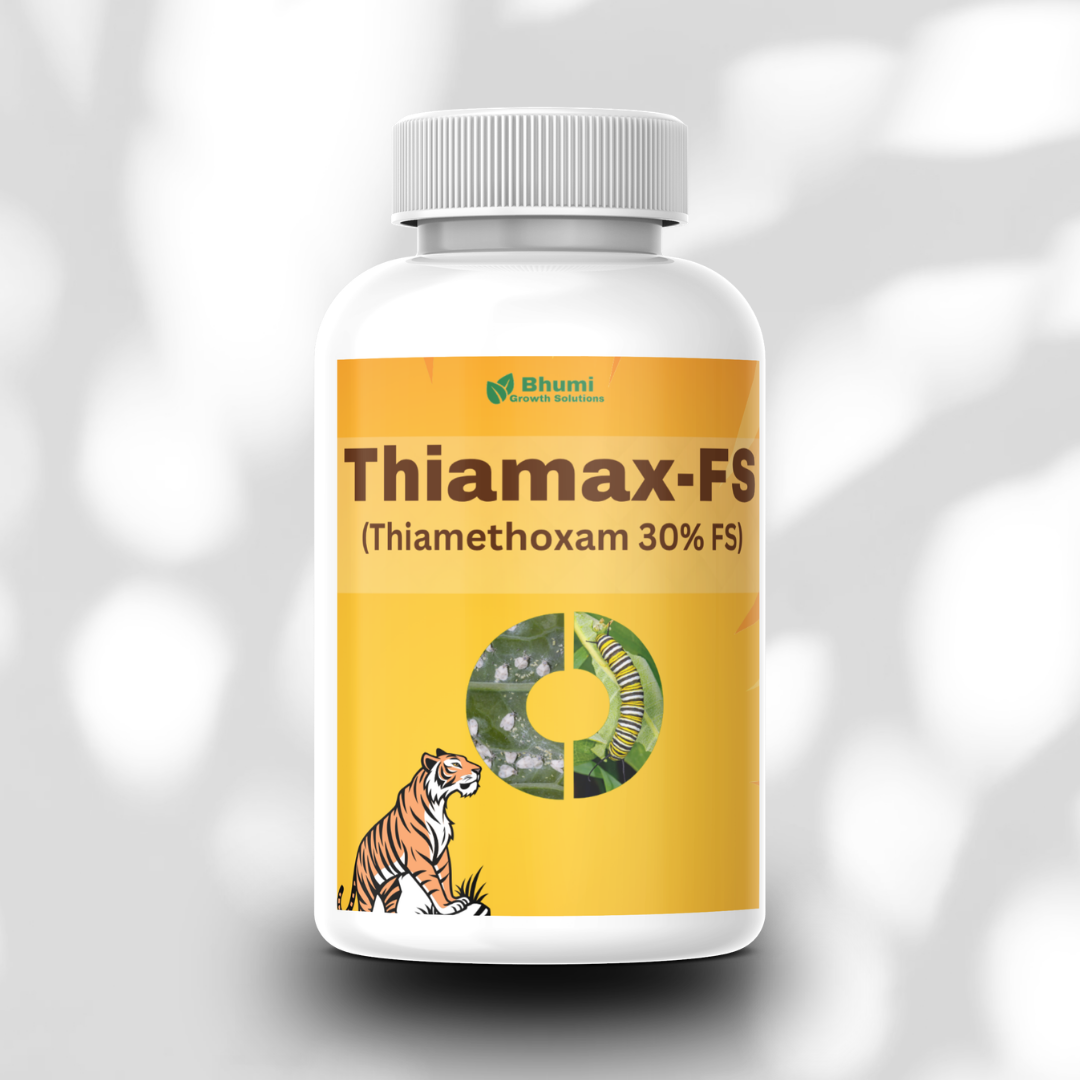
Thiamax-FS is Bhumi Growth Solutions’ advanced Thiamethoxam 30% w/v Flowable Suspension (FS) seed treatment insecticide — a second-generation neonicotinoid that is absorbed directly into the germinating seed and systemically translocated throughout every developing plant tissue as the crop grows. Unlike foliar sprays that work from the outside in, Thiamax-FS provides “inside-out” protection — the active ingredient is already present inside the plant when pest attack begins, eliminating the window of vulnerability between pest arrival and farmer response.
Seed treatment is one of the most efficient, economical, and environmentally responsible methods of insecticide application. By treating only the seed — rather than broadcasting chemicals across the entire crop canopy — Thiamax-FS places the active ingredient precisely where it is needed (inside the germinating plant), dramatically reducing total pesticide use while delivering superior early-season pest management. The result is better crop establishment, stronger seedlings, and a significantly reduced pest pressure burden throughout the first 4–6 weeks of the crop’s life.
Thiamethoxam is a second-generation neonicotinoid — chemically distinct from Imidacloprid (Bhumi’s IMIDA-178, IMIDA Max-305, and SAFAYA-70) within the same IRAC Group 4A, with a unique metabolic pathway and soil mobility profile that makes it especially effective as a seed treatment active ingredient. It is the active ingredient in Syngenta’s globally renowned Cruiser 30FS — one of the most extensively researched and widely used seed treatment insecticides in global agriculture.
What is an FS Formulation and Why Does It Matter?
FS (Flowable Suspension for Seed Treatment) is a specialised formulation type designed specifically for application to seeds before sowing. Key FS formulation properties include:
- Flowable Consistency: The FS viscosity is precisely engineered to flow evenly over seed surfaces when tumbled in a drum or hand-applied — covering every seed with a uniform, accurate dose of active ingredient without clumping or uneven distribution.
- Strong Seed Adhesion: FS formulations contain polymeric binders that help the active ingredient adhere firmly to the seed coat — preventing powder-off (active ingredient loss from treated seeds during handling, bagging, and drilling) and ensuring the AI reaches the germinating root zone.
- Water-Based Carrier: Unlike EC formulations with organic solvents, FS is water-based — making it safer to handle during seed treatment and reducing phytotoxicity risk to germinating seeds. The water carrier also facilitates rapid uptake into the seed during imbibition.
- Coloured for Visibility: Thiamax-FS’s characteristic orange-red colour immediately identifies treated seeds and prevents treated seeds from being mistaken for untreated grain — a critical safety feature to prevent accidental human or animal consumption.
- Compatibility: Thiamax-FS is compatible with fungicidal seed treatments (thiram, captan, mancozeb-based seed treatment fungicides) — enabling a single combined application of insecticide + fungicide protection to seeds before sowing.
How Does Thiamax-FS Work? (Mode of Action)
- Seed Absorption & Germination Uptake: When treated seeds are sown and begin to absorb soil moisture (imbibition), Thiamethoxam dissolves from the seed coat and is immediately taken up by the germinating radicle (primary root) and coleoptile along with water. This uptake begins within hours of sowing — making the AI systemically available inside the seedling before it even emerges from the soil.
- Xylem Translocation — Upward Movement: Thiamethoxam moves through the xylem (water-conducting tissue) of the developing plant — travelling upward from the root system into the stem, leaves, petioles, and growing points. Because the active ingredient is dissolved in the transpiration stream, it continuously reaches new plant tissue as the crop grows — including the newest leaves that emerge after sowing.
- nAChR Competitive Modulation (IRAC 4A): Thiamethoxam acts as a competitive modulator of nicotinic acetylcholine receptors (nAChRs) in the insect nervous system. When a sucking pest (aphid, whitefly, jassid) begins feeding on plant sap from treated tissue, it ingests Thiamethoxam along with the phloem sap. The AI then binds to nAChRs in the insect’s nerve cells — blocking acetylcholine from binding, interrupting normal nerve transmission, causing continuous nerve stimulation, paralysis, and death.
- Soil Pest Action: Thiamethoxam released from the seed coat also diffuses into the surrounding rhizosphere (root zone soil) — creating a protective chemical zone around the germinating seed and young root system that kills soil-dwelling pests (white grubs, termites, wireworms, cutworms) that attack seeds and roots in the crucial germination phase.
- Residual Systemic Duration: The systemic protection from a single seed treatment application typically lasts 4–8 weeks after germination, depending on crop growth rate, soil conditions, and pest pressure. This covers the entire early crop establishment phase — the period when crops are most vulnerable to pest-induced stand failure.
Thiamethoxam vs Imidacloprid: Both IRAC 4A, But Different
Though both belong to IRAC Group 4A (Neonicotinoids), Thiamethoxam and Imidacloprid have important differences that make Thiamax-FS the preferred choice for seed treatment applications:
| Parameter | Thiamethoxam (Thiamax-FS) | Imidacloprid (IMIDA Range) |
| Chemical Sub-Class | Thiamethoxam (oxadiazine ring structure) | Imidacloprid (chloronicotinyl) |
| Primary Application | Seed treatment (FS) — before sowing | Foliar spray — on growing crop |
| Soil Mobility | Higher soil mobility → better root zone distribution | Moderate soil mobility |
| Metabolic Activation | Partially metabolised to Clothianidin (another neonicotinoid) in plant tissue — extended activity | Direct action without active metabolites |
| Xylem Translocation | Exceptionally high — rapid whole-plant distribution | Good but lower than Thiamethoxam |
| Seed Treatment Effectiveness | Proven globally as gold-standard seed treatment AI (Cruiser) | Less suited to FS seed treatment |
| Early Vigour Effect | Documented plant growth promotion effect (“Green Effect”) | Primarily pesticidal action |
| Bhumi Product | Thiamax-FS (30% FS) — Seed Treatment | IMIDA-178 / IMIDA Max-305 / SAFAYA-70 — Foliar |
Target Pests
| Target Pest (Scientific Name) | Key Crop(s) & Notes |
| Aphids (Aphis gossypii, Myzus persicae) | Cotton, Wheat, Soybean, Vegetables — sucking pest from seedling stage |
| Whiteflies (Bemisia tabaci) | Cotton, Tomato, Chilli — vector of leaf curl virus |
| Jassids / Leafhoppers (Amrasca biguttula) | Cotton, Okra — early crop pest |
| Thrips (Thrips tabaci) | Cotton, Onion, Vegetables — early sucking pest |
| Green Leafhopper / GLH (Nephotettix virescens) | Rice — vector of Rice Tungro Virus |
| Brown Planthopper / BPH (Nilaparvata lugens) | Rice — key sucking pest |
| Mealy Bugs (Phenacoccus solenopsis) | Cotton — early stage protection |
| White Grubs (Holotrichia spp.) | Groundnut, Soybean, Sugarcane — soil pest damaging roots |
| Termites (Odontotermes spp.) | Cotton, Soybean, Wheat — soil pest attacking germinating seeds and roots |
| Wireworms (Agriotes spp.) | Wheat, Maize — soil pest attacking germinating seeds |
| Cutworms (Agrotis spp.) | Cotton, Vegetables — soil-surface pest cutting seedling stems |
| Shoot Fly (Atherigona soccata) | Sorghum — early crop pest attacking seedling growing point |
| Thrips & Aphids combined | Sunflower — early stage protection |
CIB-Verified Crop-Wise Seed Treatment Dosage Table
NOTE: Doses are in ml per kg of seed (seed treatment rate), NOT per acre.
| Crop | Target Pests | Method | Dose (per kg seed) | Water Required | Rate | PHI |
| Cotton | Aphids, Whiteflies, Jassids, Thrips, Mealy Bugs, Termites | Seed Treatment | 3–5 ml per kg seed | Sufficient water to coat evenly | 3–5 ml/kg | — |
| Soybean | Aphids, Whiteflies, White Grubs, Termites | Seed Treatment | 3–4 ml per kg seed | Sufficient water to coat evenly | 3–4 ml/kg | — |
| Wheat | Aphids, Termites, Wireworms | Seed Treatment | 1.9–2 ml per kg seed | Sufficient water to coat evenly | 1.9–2 ml/kg | — |
| Rice (Nursery/Direct) | GLH, BPH, Gall Midge, Thrips | Seed Treatment (pre-sowing) | 3 ml per kg seed | Sufficient water to coat evenly | 3 ml/kg | — |
| Sorghum / Jowar | Shoot Fly | Seed Treatment | 4–5 ml per kg seed | Sufficient water to coat evenly | 4–5 ml/kg | — |
| Sunflower | Aphids, Thrips, Whiteflies | Seed Treatment | 5–7 ml per kg seed | Sufficient water to coat evenly | 5–7 ml/kg | — |
| Maize | Aphids, Wireworms, Termites, Cutworms | Seed Treatment | 4 ml per kg seed | Sufficient water to coat evenly | 4 ml/kg | — |
| Vegetables (Tomato, Chilli, Brinjal) | Aphids, Whiteflies, Thrips | Seed Treatment | 4–5 ml per kg seed | Sufficient water to coat evenly | 4–5 ml/kg | — |
| Groundnut | Aphids, White Grubs, Termites | Seed Treatment | 3–4 ml per kg seed | Sufficient water to coat evenly | 3–4 ml/kg | — |
| Sugarcane (Setts) | Termites, Scale insects | Sett dip treatment | 2 ml per litre of water | As dip solution | 2 ml/L | — |
💡 DOSAGE QUICK REFERENCE:
• Cotton (450g seed packet): 2–3 ml of Thiamax-FS per packet
• General rate: 3–5 ml per kg of seed
• Always add small amount of water (5–10 ml/kg) to help spread the coating evenly
• Allow treated seeds to dry in shade for 30 minutes before sowing
• Do NOT use more than the recommended dose — excess coating may affect germination
How to Apply Thiamax-FS: Step-by-Step Seed Treatment Guide
- Step 1: Wear full PPE (gloves, goggles, mask) before handling — Thiamethoxam is a systemic insecticide; avoid skin contact and inhalation during seed treatment
- Step 2: Weigh the exact quantity of seeds to be treated; record the weight to calculate the correct Thiamax-FS dose
- Step 3: Measure the exact dose of Thiamax-FS using a graduated syringe or measuring cylinder
- Step 4: Place the seeds in a clean plastic drum, bucket, or polythene sheet
- Step 5: Add 5–10 ml of clean water per kg of seed to the measured Thiamax-FS to improve flowability and even coating
- Step 6: Pour the diluted Thiamax-FS solution over the seeds and mix/tumble thoroughly for 3–5 minutes — ensure every seed has a uniform orange-red coating
- Step 7: Spread treated seeds in a single layer on a clean, dry surface in the shade and allow to air-dry for 30–60 minutes
- Step 8: Treated seeds must be sown within 24 hours of treatment for best results — do not store treated seeds for extended periods
- Step 9: Dispose of any leftover treating solution and containers safely; never use treated seeds for food, feed, or oil extraction
- Step 10: Record the date and dose of treatment for traceability
Seed Treatment vs Foliar Spray: Why Thiamax-FS is More Efficient
| Parameter | Thiamax-FS Seed Treatment | Foliar Insecticide Spray |
| Active Ingredient Location | Inside plant tissue from day 1 — pest encounters AI when feeding | On leaf surface — pest must land where spray reached |
| Protection Timing | Immediate from germination — no gap in protection | Applied after pest arrival — crop damage may already occur |
| Spray Inputs Required | Zero early-season sprays needed (4–8 weeks) | 1–3 additional sprays needed for same coverage period |
| Labour Cost | One application at seed treatment — no field spray labour | Multiple field entry and spray operations required |
| Environmental Exposure | Minimal — AI inside plant, not broadcast in field | Broader environmental exposure from foliar application |
| Bee/Pollinator Risk | Lower during early crop stage (before flowering) | Higher exposure risk if applied during flowering period |
| Soil Pest Coverage | Yes — seed zone soil protection for white grubs, termites | Poor — foliar spray reaches soil minimally |
| Seed Vigour Effect | Documented early plant growth stimulation (Thiamethoxam “Green Effect”) | No direct plant growth effect |
| Farmer Convenience | Treat once, protect for 4–8 weeks automatically | Regular field monitoring and spray scheduling required |
Key Benefits at a Glance
- ✅ IRAC Group 4A Second-Generation Neonicotinoid — More systemic, higher xylem mobility than Imidacloprid
- ✅ Systemic Protection from Day 1 — Inside plant before first pest arrives; no vulnerability window
- ✅ Eliminates Early-Season Foliar Sprays — 4–8 weeks systemic protection from one application
- ✅ Soil Pest Protection — Termites, White Grubs, Wireworms, Cutworms in seed germination zone
- ✅ Broad Pest Spectrum — Aphids, Whiteflies, Jassids, Thrips, GLH, BPH, Shoot Fly, Mealy Bugs
- ✅ Virus Vector Control — Protects against Whitefly-transmitted Leaf Curl Virus and GLH-transmitted Rice Tungro
- ✅ Documented Seedling Vigour Effect — Thiamethoxam “Green Effect” = better early crop stand and root development
- ✅ Economical Application — Single seed treatment; no spray equipment, fuel, or field labour needed
- ✅ FS Formulation Advantages — Flowable, uniform coating, strong seed adhesion, water-based, coloured
- ✅ Compatible with Fungicidal Seed Treatments — Combine with thiram/captan/mancozeb seed treatment fungicides
- ✅ Broad Crop Registration — Cotton, Soybean, Wheat, Rice, Sorghum, Sunflower, Maize, Vegetables, Groundnut
- ✅ Custom Pack Sizes — 100 ml to bulk quantities for every farm and seed treatment operation
Available Pack Sizes
Standard Size: 1 Litre
Custom Sizes: 100 ml | 250 ml | 500 ml | 1 Litre | Bulk quantities
Recommended Crop Protection Programme with Thiamax-FS
🌱 COMPLETE BHUMI COTTON SEASON PROGRAMME (Example):
📌 PRE-SOWING (Day 0): Thiamax-FS Seed Treatment
→ Protects: Aphids, Whiteflies, Jassids, Thrips, Mealy Bugs, Termites from germination
→ Duration: 4–6 weeks systemic protection
📌 WEEKS 6–8 (When Thiamax-FS activity expires):
Begin foliar spray programme — Spray 1: IMIDA-178 / IMIDA Max-305 (IRAC 4A foliar)
📌 WEEKS 8–10: Spray 2: Profex Duo (IRAC 1B + 3A) — for bollworm + sucking pest combination
📌 WEEKS 10–12: Spray 3: Professor 50 (IRAC 1B) or StrikeForce (IRAC 3A) — rotation
📌 OPTIONAL: NEEMOLI-15 (Bio-Pesticide) — organic rotation spray to reduce chemical load
✅ RESULT: Complete season coverage from seed to harvest using the full Bhumi product range
Safety, Precautions & First Aid
⚠️ IMPORTANT:
• Treated seeds are ORANGE-RED in colour — clearly visible to prevent accidental consumption
• NEVER use Thiamax-FS-treated seeds for food, animal feed, or oil extraction
• Keep treated seeds away from children, birds, and animals at all times
• Thiamethoxam is HIGHLY TOXIC to honeybees and aquatic organisms
- Always wear chemical-resistant gloves, goggles, and mask during seed treatment — do not allow skin contact with the treating solution
- TREATED SEEDS ARE NOT FOOD — Never use Thiamax-FS treated seeds for human consumption, animal feed, bird food, or oil extraction — the seeds are clearly coloured orange-red to indicate treatment
- Keep treated seeds secured in labelled containers away from children, birds, wildlife, and domestic animals until sowing
- Sow treated seeds promptly — preferably within 24 hours; do not leave treated seeds accessible to non-target organisms
- Store Thiamax-FS in original tightly sealed container in a cool (below 30°C), dry, locked location away from children, food, and water sources
- Thiamethoxam is HIGHLY TOXIC to bees and other pollinators — dispose of any leftover seed treatment liquid and seed treatment equipment washwater safely; NEVER pour down drains or into water bodies
- If skin contact: Immediately wash with soap and water for 15 minutes
- If eye contact: Flush immediately with clean running water for 15–20 minutes; seek ophthalmologist consultation
- If inhaled: Move to fresh air; seek medical attention if symptoms persist
- If ingested: Do NOT induce vomiting; seek IMMEDIATE emergency medical care; bring product label to physician
- Triple-rinse all seed treatment containers before disposal; never reuse containers
- Dispose of treated seed waste by deep burial away from water bodies; never leave treated seeds exposed
Frequently Asked Questions (FAQs)
Q1. What does “FS” mean and is Thiamax-FS a foliar spray?
FS stands for Flowable Suspension for Seed Treatment. Thiamax-FS is NOT a foliar spray — it is applied exclusively to seeds before sowing. The seeds are coated with the orange-red FS solution, allowed to dry, and then sown in the field. The Thiamethoxam is absorbed into the germinating seedling and translocated systemically through the plant to provide protection against sucking and soil pests.
Q2. How long does Thiamax-FS protection last after seed treatment?
Thiamax-FS typically provides 4–8 weeks of systemic protection after germination, depending on the crop growth rate, soil conditions (temperature, moisture), and pest pressure level. After this period, the concentration of Thiamethoxam in plant tissue drops below effective pest control thresholds. At this point, farmers should initiate foliar spray protection using IMIDA-178, IMIDA Max-305, or other Bhumi crop protection products.
Q3. What is the correct dose of Thiamax-FS per kg of seed?
Cotton: 3–5 ml/kg seed. Soybean: 3–4 ml/kg. Wheat: 1.9–2 ml/kg. Rice: 3 ml/kg. Sorghum: 4–5 ml/kg. Sunflower: 5–7 ml/kg. Maize: 4 ml/kg. Vegetables: 4–5 ml/kg. Source: Multiple CIB-registered Thiamethoxam 30% FS product labels.
Q4. Can Thiamax-FS be mixed with fungicidal seed treatments?
Yes. Thiamax-FS is compatible with most fungicidal seed treatments such as thiram, captan, and mancozeb-based seed treatment fungicides. This allows a single combined seed treatment operation providing both insecticidal and fungicidal protection. Always test compatibility before large-scale mixing and follow both product label instructions for combined application rates.
Q5. Why is Thiamax-FS (Thiamethoxam) better than Imidacloprid for seed treatment?
While both are IRAC Group 4A neonicotinoids, Thiamethoxam has higher soil mobility, faster xylem translocation throughout the plant, and is partially metabolised to Clothianidin (another neonicotinoid) inside plant tissue — providing extended systemic activity. Thiamethoxam also has a documented plant growth stimulation effect (“Green Effect”) that improves seedling vigour and root development. These properties make Thiamethoxam the global gold standard for neonicotinoid seed treatment applications.
Q6. Are treated seeds safe to handle?
Treated seeds should be handled with gloves and kept away from children, birds, and animals. The orange-red colour distinguishes treated seeds from untreated grain. NEVER use Thiamax-FS treated seeds for food, animal feed, or oil extraction — the active ingredient is systemic within the seed. Sow treated seeds promptly and store any unused treated seeds securely in labelled containers.


Reviews
There are no reviews yet.